
Social Stories

A Story About Talking About My Favorite Thing without being told to stop.

Your child has been told they talk about one subject too much, and now they have stopped talking about the thing they love most, and about most other things too.

Free 7-day trial · No email or credit card to start · Built by an autism dad and a licensed SLP

Why it works here

Why a social story helps with a story about talking about my favorite thing

The usual advice here asks a child to suppress genuine enthusiasm, which costs more than it gains. A better story teaches how to notice interest and how to find people who share it, so the interest stays intact and the exchange improves.

You will recognize this if

  • Your child has been told they talk too much about one thing.
  • They have become quieter across the board since.
  • Peers disengage and your child does not notice.
What the research says

Special interests function as a genuine engine for skill building and motivation rather than as a behavior to be reduced.

VizyPlan, Special interests as a skill engine
The setup

How to set it up for a story about talking about a special interest

Takes about five minutes. Use it as written, or keep only the steps your family needs. A short setup that gets used beats a complete one that gets abandoned in week two.

  1. 1 Say clearly that loving something deeply is a good thing
  2. 2 Explain that conversation goes both ways, with a concrete cue to swap
  3. 3 Give observable signs of interest rather than asking them to read faces
  4. 4 Teach asking one question back as a specific habit
  5. 5 Help them find people who share the interest, where the rule relaxes
  6. 6 Never frame the interest itself as the problem
The mistake most families make

A story that tells a child to stop talking about what they love teaches suppression rather than reciprocity, and the cost usually spreads well beyond that topic.

In the app

Built into the routine, not bolted onto it.

The Social Stories lives inside the same routine your child already follows, so a story about talking about a special interest is a step with a visible length rather than a separate tool somebody has to remember to open.
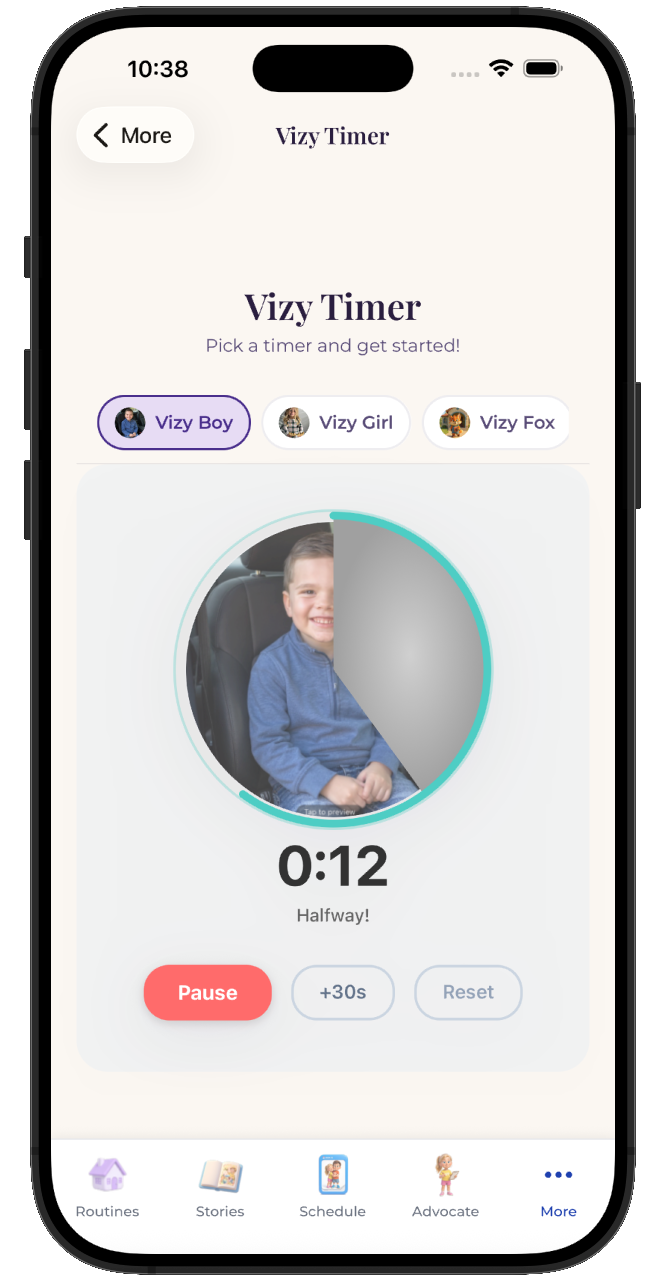
  • Attach it to any step in any routine
  • Works for pre-readers, gestalt language processors, and AAC users
  • Same setup at home, at school, and in therapy
See the step-by-step guide →
The VizyPlan Social Stories set up for a story about talking about a special interest

Set this up for your child.

Five minutes to build, and your child sees it every time a story about talking about a special interest comes around.

$6.99/month after the free trial · Cancel anytime · Also at app.vizyplan.com

Common questions

About a story about talking about a special interest

Should I limit how much my child talks about their interest?
Teach reciprocity rather than limits. The goal is a two-way exchange, not a quieter child.
How do I teach noticing disinterest?
Use observable signals like looking away or not answering, rather than facial expression. Concrete cues are usable and subtle ones are not.
Where can my child talk freely?
With people who share the interest, and it is worth actively finding those settings. Shared-interest groups are frequently where friendships actually form.

VizyPlan supports routines and communication at home and school. It is not a medical device and does not diagnose or treat any condition. Talk to your child's care team about clinical questions.