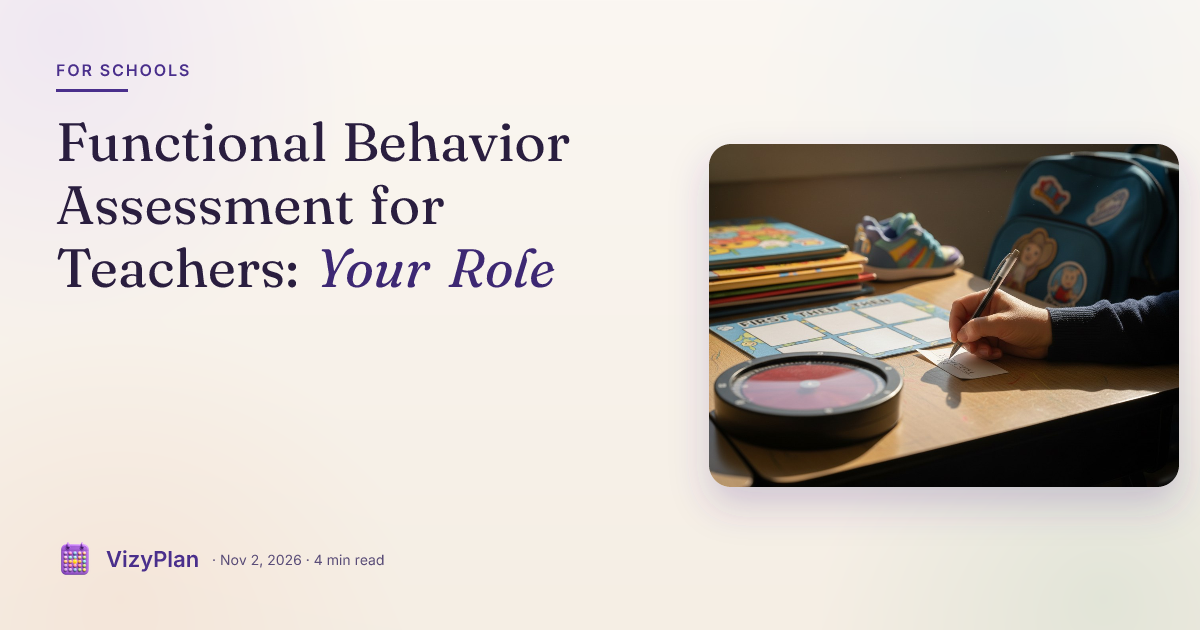


Thanksgiving week looks short on the calendar. For many autistic students, a short week is a long list of changes: a half day on Wednesday, a class party, an assembly, three classmates already gone on a trip, maybe a substitute. The goal for teachers is not a week without changes. The goal is a Thanksgiving week autistic students can predict, because every change was posted before it happened.
Why a short week can feel like a hard week
Researchers have described distress at change since the earliest writing on autism. The Interactive Autism Network at Kennedy Krieger Institute notes that many autistic people show an insistence on sameness and can become upset, sometimes extremely upset, when an unwelcome change hits a pattern or routine.
A normal week has one or two surprises. A holiday week stacks five or six into three days, and each surprise lands on a student who may already be tired from a fall full of schedule changes like picture day and early release. The schedule is not the problem. Not knowing the schedule is.
What the research supports
Two well-studied practices fit a Thanksgiving week autistic students can predict. A 2015 review in the Journal of Autism and Developmental Disorders by Knight, Sartini and Spriggs examined visual activity schedule research from 1993 to 2013. Of 31 studies, 16 met quality criteria, and the authors concluded that visual activity schedules can be considered an evidence-based practice for autistic individuals, especially when paired with systematic instruction.
The 2020 report from the National Clearinghouse on Autism Evidence and Practice also lists visual supports among its evidence-based practices. A related strategy is priming. A Tri-State Autism Collaborative guide hosted by the University of Nebraska-Lincoln describes priming as previewing materials or activities, often the day or morning before, to add predictability and reduce stress, and notes that priming for a school day can take less than 10 minutes.
Planning a Thanksgiving week autistic students can follow
- Post the changed schedule the week before. Put the real Thanksgiving week schedule up the Friday before, next to the regular one. Mark each change with the same symbol so students can spot them: the assembly, the party, the early release.
- Name the people who will be different. If a substitute or a specialist is covering a block, add a photo and a name to the schedule. Our substitute teacher plan covers what to leave behind.
- Prime each day the morning of. Spend a few minutes at arrival walking through that day only. Show the actual party plate, the assembly seats, or the dismissal line for the early bell.
- Keep three anchors fixed. Pick routines that stay the same all week, such as the morning greeting, the snack spot and the closing circle. Anchors give Thanksgiving week autistic students something familiar to hold onto between the changes.
- Plan the party like a lesson. Give the party a start, a short list of stations and a clear end on the schedule. The approach from our classroom Halloween party guide carries straight over to a Thanksgiving celebration.
- Protect a quiet option. Holiday rooms get loud. Keep a calm corner open and on the schedule, the same way an indoor recess plan builds in a low-noise choice.
Enjoying this article?
Get practical tips and insights delivered to your inbox — no spam, ever.
Preview the break, not just the week
The last piece of a Thanksgiving week autistic students can trust is the break itself. A half day on Wednesday can feel like the floor drops out. Show the break itself on the schedule: no school Thursday and Friday, a weekend, then a picture of the classroom with "Back on Monday." In 2026, Thanksgiving falls on November 26, so the return is Monday, November 30. A visible return date tells students the routine is paused, not gone.
Send the same break preview home. Families can use the pictures to count down at the kitchen table, and the shared language keeps home and school saying the same thing.
Plan the Monday after break
The Monday after Thanksgiving is a second transition, and many plans for a Thanksgiving week autistic students can handle stop one day too early. Treat re-entry as its own short plan:
- Post Monday's schedule before break. Students who saw the Monday plan on Wednesday walk back into something they already know.
- Open with the anchors. Start with the same greeting and first routine from before the holiday, before any new unit or seating change.
- Hold the big changes. If December brings concerts, new seats or a new unit, give students a few regular days first.
- Expect a slower start. Shorter work blocks and more breaks on Monday and Tuesday are a reasonable plan, not a step backward.
VizyPlan was built by an autism dad and an autism mom who is a licensed speech-language pathologist so a changed school week can be a set of pictures a student sees at home and at school.
Share VizyPlan with your families so the Thanksgiving week schedule and the countdown to Monday look the same at home. Families can try it free for a week. If it helps, they can keep going for $6.99/month or $59.99/year.
VizyPlan was built by an autism dad and an autism mom who is a licensed speech-language pathologist who needed something that did not exist. Explore VizyPlan.