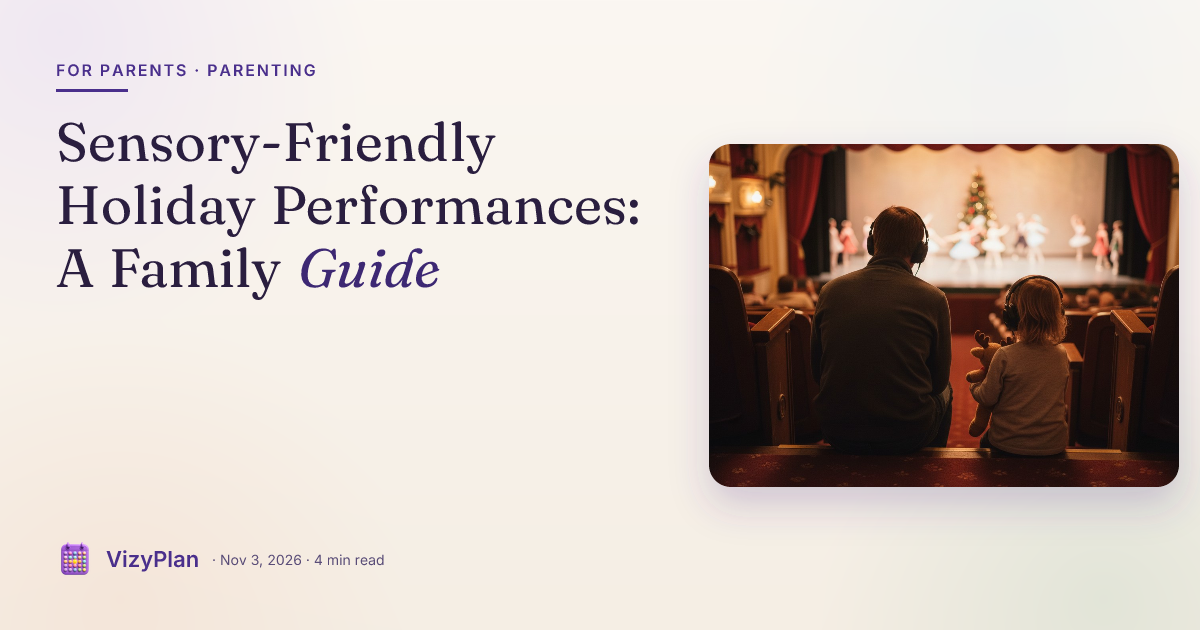
A holiday show can be the best two hours of December or the longest. The Nutcracker, a holiday concert, a pantomime or a children's theater show all ask a lot: a dark room, sudden loud music, a crowd, and sitting still. Sensory-friendly holiday performances change those rules, and more theaters offer them every year.
If your autistic child loves music or stories, sensory-friendly holiday performances may be the easiest way to try a live show without betting the whole evening on it.
What changes at sensory-friendly holiday performances
The details vary by theater, but the pattern is consistent. The Philadelphia Ballet runs a sensory-friendly Nutcracker with house lights left on at a low level, lower sound throughout, and permission for guests to talk, leave their seats and move around. A designated quiet area is set up in the building, and the ballet lends a limited number of noise-cancelling headphones and fidgets.
The American Repertory Theater lists similar changes: house lights dimmed rather than off, softer lighting and sound effects, a staffed quiet area, and a lobby room with a live video feed so a family can keep watching from outside. Tablets and phones are allowed for kids who use them to communicate. Other theaters add advance warnings before loud moments or remove strobe lights entirely.
In the UK the same idea is called a relaxed performance. Andy Kempe at the University of Reading studied relaxed performances, including a relaxed pantomime, and described in Support for Learning (2014) how the shared attention of watching theater together can be a meaningful social experience for autistic children and their families.
The biggest change is not technical. The biggest change is the audience. Everyone in the room expects some noise, some movement and some exits, so nobody turns around.
How to plan for sensory-friendly holiday performances
- Find the show early. Search your local ballet, symphony, children's theater and touring Broadway house for "sensory friendly" or "relaxed performance." Holiday dates often sell out, and many theaters schedule only one or two.
- Preview the show. Many theaters post a social story or pre-visit guide with photos of the building, the seats and the characters. Add trailer clips and a few minutes of the music, so the loud parts are already familiar.
- Choose seats you can leave. An aisle seat near the back, close to an exit, makes a break easy. Some families prefer the side so their child can see the stage without people directly in front.
- Pack a sensory kit. Headphones or ear defenders, a comfort item, a fidget, a familiar snack if the theater allows food, and a water bottle. A small study by Pfeiffer and colleagues in Frontiers in Integrative Neuroscience (2019) followed six autistic children and found measurable differences in skin conductance, a body signal tied to stress, when they wore noise-attenuating headphones.
- Plan intermission on purpose. Intermission is crowded and loud. Decide ahead of time whether you will head to the quiet room, step outside, or stay seated while the lobby empties.
- Agree on an early exit. Leaving at intermission is a win, not a failure. Put "go home" on the plan as a real option, so your child knows they can stop.
Enjoying this article?
Get practical tips and insights delivered to your inbox — no spam, ever.
Make the outing a visual plan
The night of the show has more steps than the show itself: the drive, parking, the lobby, finding seats, the first half, intermission, the second half, and the trip home. Lay those steps out in pictures, in order, and walk through them a few days before. Mark the quiet room and the exit on the plan so your child can point to them during the show.
If your child struggled at a show before, start smaller. A 45-minute children's concert or one act of a ballet is plenty for a first try. Sensory-friendly holiday performances are designed for families to come and go, so a short visit still counts.
Our posts on a sensory-friendly Santa visit and holiday shopping with an autistic child use the same preview, pack and exit approach, and our guide to opening presents with an autistic child covers the morning after.
VizyPlan was built by an autism dad and an autism mom who is a licensed speech-language pathologist so the night of the show, from the car to the curtain to the drive home, can live in a picture plan your child already knows how to read.
Download VizyPlan and start your 7-day free trial today. Build the show night plan now and practice it before the tickets come out. If it helps, keep going for $6.99/month or $59.99/year.
VizyPlan was built by an autism dad and an autism mom who is a licensed speech-language pathologist who needed something that did not exist. Start your free trial.