Fidgets in the classroom start more staff-room arguments than almost any other sensory support. One teacher has watched a stress ball turn a restless student into a focused one. Another has spent a week retrieving spinners from under desks. Both teachers are right, and the research explains why.
The honest summary is that the evidence is mixed, and the type of fidget matters more than the word "fidget." A quiet hand fidget used without looking is a very different tool from a spinning toy that pulls the eyes.
What research says about fidgets in the classroom
The most cited study is a warning. In a 2018 study in the Journal of Attention Disorders, Graziano, Garcia and Landis gave fidget spinners to young children with ADHD, average age about five, during a structured classroom program. Attention got worse when the children had spinners, and the small early drop in wandering faded by the end. Classmates were not affected. The sample was small and very young, but the result is clear enough to keep spinners out of instruction time.
Movement itself tells a different story. A 2015 study in the Journal of Abnormal Child Psychology by Sarver, Rapport and colleagues found that boys aged 8 to 12 with ADHD performed better on working memory tasks when they moved more, while typically developing boys did slightly worse with more movement. A UC Davis study led by Julie Schweitzer's lab in 2015 found that students aged 10 to 17 with ADHD moved more intensely on the questions they answered correctly than on the ones they got wrong.
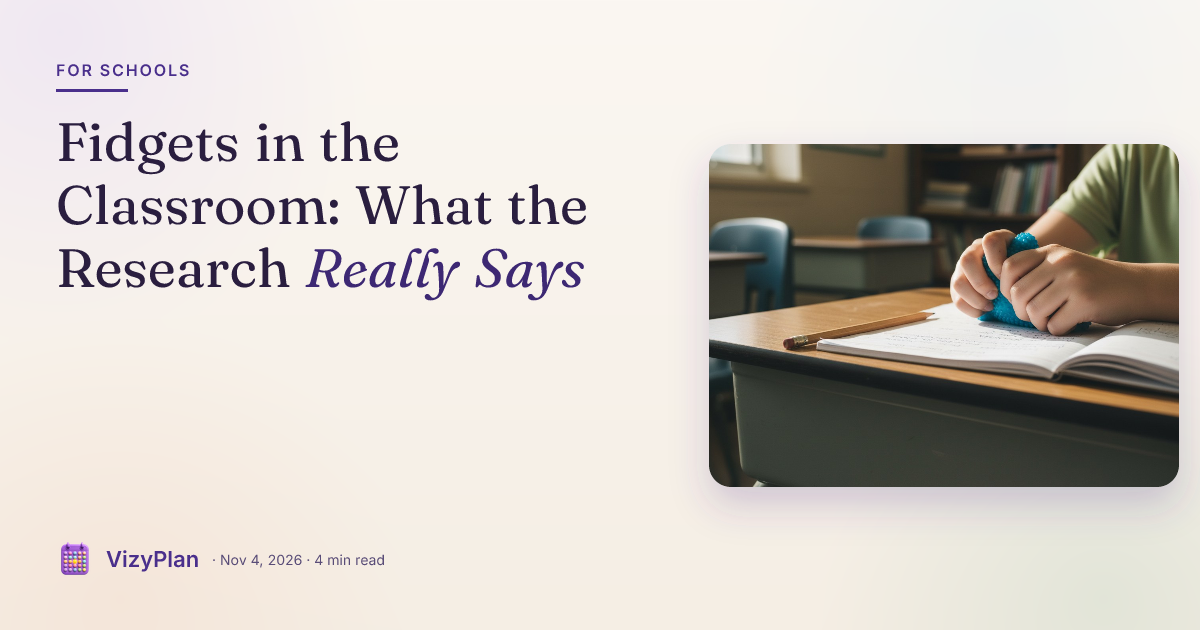
For hand fidgets specifically, the evidence is thinner. A small 2006 study by Stalvey and Brasell in a sixth-grade class found fewer distraction incidents when students used stress balls, and the authors called their own findings preliminary. Research on autistic students and fidgets is limited, so school teams should rely on careful observation of each student rather than a blanket rule.
What the research supports, then, is a narrow claim: some movement can help some students with ADHD think, and fidgets that demand visual attention tend to hurt. Fidgets in the classroom work best when they keep the hands busy and leave the eyes and the ears free.
Which fidgets are quiet enough for instruction
The best fidgets in the classroom pass three tests: silent, usable without looking, and boring to watch.
- Usually good choices: stress balls, putty or therapy dough, a strip of velcro or textured tape under the desk, stretchy bands on chair legs, a smooth worry stone, a bendable wire figure, a smooth pencil grip to squeeze.
- Usually poor choices for instruction: spinners, clicking cubes, pop-it toys that snap loudly, anything that lights up, anything that rolls off the desk.
- Seating counts too. A wobble cushion or a standing spot at the back gives larger movement without any object at all.
Our guide to the sensory-friendly classroom covers more low-cost setups that reduce the need for an object in the first place.
Enjoying this article?
Get practical tips and insights delivered to your inbox — no spam, ever.
How to teach fidgets in the classroom as tools, not toys
Fidgets in the classroom without expectations become toys within a day. Teaching the rule up front protects the students who need the tool.
- Define tool vs. toy in one sentence. A tool helps your body so your brain can learn. A toy takes your eyes or someone else's attention. Post the sentence with a picture of each.
- Teach the expectations with a visual. Hands only, stays in my space, no sound, eyes on the lesson. Model the right way and the wrong way, then let students practice.
- Offer a small menu, not a bin. Two or three quiet options keep choosing fast and trading rare.
- Use a calm reset, not a confiscation. If a fidget turns into a toy, it goes on the desk corner for a few minutes, then the student tries again. Removing the tool entirely punishes the need.
- Watch the work, not the hands. Note whether the student starts tasks faster or stays on task longer with the fidget. If nothing improves, try a different fidget or a movement break instead.
- Make fidgets available to everyone who follows the rules. Universal access lowers stigma, and the student who needs one most no longer stands out.
When a fidget becomes an IEP or 504 accommodation
Rules for fidgets in the classroom are a teacher's call. A fidget written into a student's plan is not. Under IDEA, an IEP can list a fidget as an accommodation or a supplementary aid, and under Section 504 of the Rehabilitation Act, a 504 plan can do the same. Once a fidget is in the plan, every adult working with that student implements it, including substitutes, specials teachers and testing staff.
Teams usually move a fidget into the plan when a classroom ban, a new teacher or state testing keeps getting in the way. Write it specifically: which type of fidget, which settings and what happens if it becomes a distraction. Understood.org offers a free fidget contract that asks students, families and teachers to agree on those details together. Our guide to making IEP accommodations happen in week one covers how to get every adult on the same page, and families looking at the bigger picture can read 504 plan vs. IEP.
VizyPlan was built by an autism dad and an autism mom who is a licensed speech-language pathologist so the tool vs. toy rules students learn at school can be the same picture card they see at home.
Share VizyPlan with your families so the fidget expectations you teach in class come home as a visual routine. The 7-day free trial lets a family try it first. If it helps, keep going for $6.99/month or $59.99/year.
VizyPlan was built by an autism dad and an autism mom who is a licensed speech-language pathologist who needed something that did not exist. Explore VizyPlan.