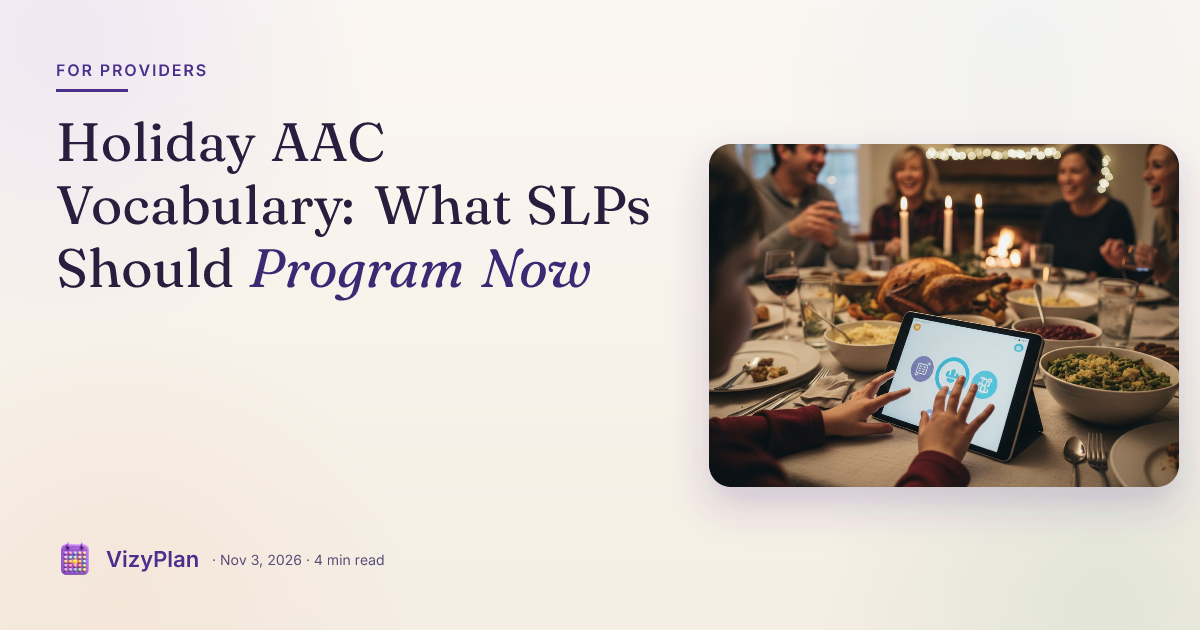
A client who uses AAC walks into a house full of people they see once a year, and the device has no button for Aunt Rosa, no word for stuffing and no quick way to say the room is too loud. Holiday AAC vocabulary is a programming job for the next two weeks of sessions, while there is still time to add the words, model them and send the family home ready.
The work has three parts: add the right fringe words, protect the core words the client already knows by location, and teach the adults at the gathering how to talk with someone who uses AAC.
Which holiday AAC vocabulary to add first
Fringe vocabulary is the specific, low-frequency set tied to one person or one event, usually nouns, usually stored below the main page. Holiday AAC vocabulary is almost entirely fringe, which is good news: none of it needs to touch the home screen.
Ask the family for a short list, not a long one. The words that carry the day usually fall into five groups:
- People. Names of the relatives and family friends who will be there, ideally with a real photo of each person. A client who can say who they want to sit next to has a lot more control over the meal.
- Foods. The six or eight dishes that will actually be on the table, including the one the client will eat and the one they will refuse.
- Gift words. "Open," "my turn," "I like it," "not for me," "later." Many of those are already core words, which matters below.
- Regulation words. "Break," "too loud," "too many people," "go outside," "headphones," "all done." Put these where the client can reach them in one or two hits.
- Social openers. A greeting, "look," and one or two comments about the event. Our guide to holiday social scripts covers which moments to rehearse.
Keep core words where the hands already know them
Adding holiday AAC vocabulary should never move a core word. A 2018 study in the American Journal of Speech-Language Pathology by Thistle and colleagues found that preschoolers searching arrays where symbols stayed in fixed positions became significantly faster across five sessions than children whose symbols moved each session. The participants were children without disabilities, and the authors called for replication with AAC users, but the finding matches what most AAC clinicians see: a stable location becomes a motor habit, and a moved word has to be searched for again.
The practical rule is simple. Add holiday words in a new folder or category one level down, link to that folder from a spot that is already empty, and leave every existing button exactly where it is. If "more," "eat" and "stop" are already on the home page, "more turkey" should be built from the existing "more" plus a new food word, not from a new phrase button somewhere else.
Model it before the visit, not during
Aided language modeling, where the partner points to symbols on the client's own system while speaking, has strong support. A 2016 systematic review by Sennott, Light and McNaughton in Research and Practice for Persons with Severe Disabilities found that partner modeling of aided AAC produced positive, large effects on pragmatic, semantic, syntactic and morphological outcomes for young children with complex communication needs. A 2018 meta-analysis by O'Neill, Light and Pope in the Journal of Speech, Language, and Hearing Research supports the same direction.
Clients need to see the new holiday AAC vocabulary used many times before they use it. Build the practice into the next few sessions and send it home:
- Introduce the folder in session. Show the client where the holiday words live and model the path to them, starting from the home page every time.
- Run a pretend meal. Use play food or photos of the real dishes. Model "more potatoes," "all done," "too loud" and the relatives' names as you play.
- Coach a parent to model at dinner. Ask the family to model two or three holiday words at real meals this month, without requiring the client to repeat them.
- Model the break words when calm. Point to "break" and "too loud" during easy moments so the path is familiar before the hard one.
- Check access the week of the visit. Confirm the device is charged, the case is packed and the volume is high enough for a noisy kitchen.
Our AAC visual schedules guide covers more on making home practice stick.
Enjoying this article?
Get practical tips and insights delivered to your inbox — no spam, ever.
Teach the relatives to wait
The other adults at the gathering are half of every exchange. A 2015 meta-analysis by Kent-Walsh, Murza, Malani and Binger in Augmentative and Alternative Communication found that teaching communication partners had positive effects on the communication of people who use AAC, and the partner skills most often taught were aided modeling, expectant delay and open-ended questions.
Expectant delay is the one relatives most need to hear. Give the family a short note to share before the visit: ask one question, then wait quietly while the person composes an answer, without guessing, finishing the sentence or repeating the question. The device is the client's voice, so nobody else should take it, and a reply that comes slowly is still a reply. Our guide to coaching extended family before the holidays covers that conversation in detail.
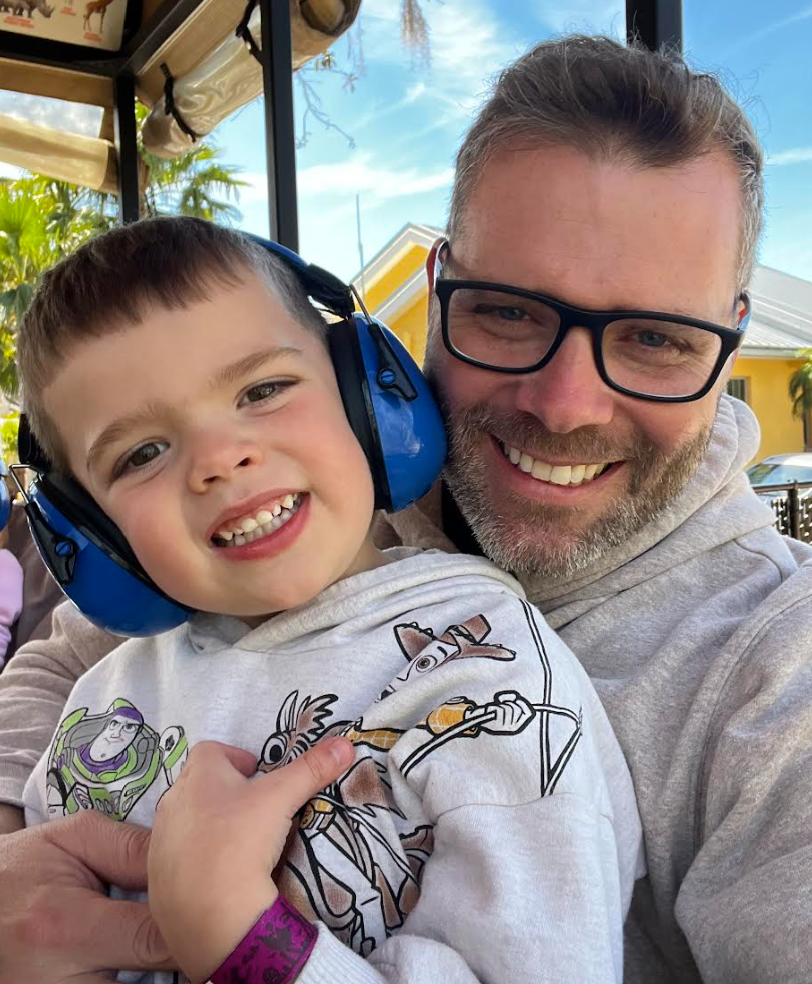
VizyPlan was built by an autism dad and an autism mom who is a licensed speech-language pathologist so a family can preview the visit, the faces and the break plan as a picture story long before anyone rings the doorbell.
Share VizyPlan with your families so the holiday AAC vocabulary you practice in session has a plan around it at home. The 7-day free trial lets a family try it first. If it helps, keep going for $6.99/month or $59.99/year.
VizyPlan was built by an autism dad and an autism mom who is a licensed speech-language pathologist who needed something that did not exist. Explore VizyPlan.