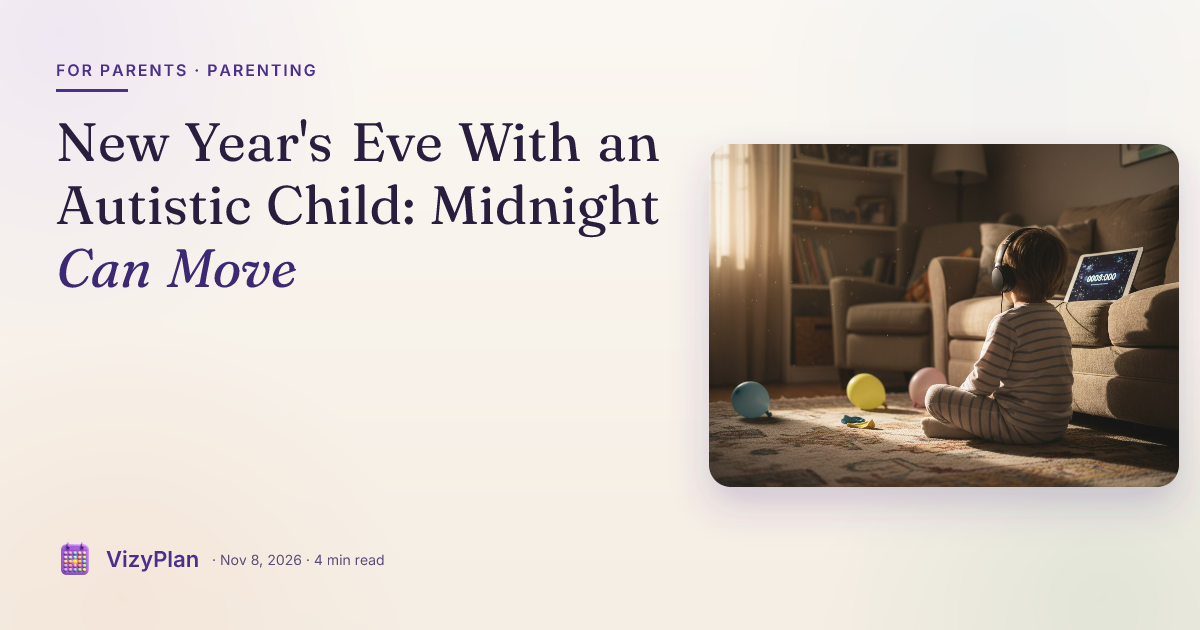
Midnight is late, loud and unpredictable. Fireworks start without warning, neighbors bang pots, and the whole evening asks a tired child to wait for a moment nobody can see coming. New Year's Eve with an autistic child gets much easier once you notice that the celebration is just a countdown, and a countdown can happen at any hour you choose.
Nothing about the new year requires your child to be awake when the calendar flips. The goal is a happy countdown, a calm bedtime and a normal morning on January 1.
Why midnight is hard for many autistic kids
Two things collide on December 31: noise and lost sleep.
Sound sensitivity is common in autism. A 2021 meta-analysis in Ear and Hearing by Williams, Suzman and Woynaroski pooled 103 estimates covering more than 13,000 autistic people and found that about 41% currently experience decreased sound tolerance, and about 61% do at some point in their lives. A 2022 survey of families in the Journal of Autism and Developmental Disorders by Scheerer and colleagues found that loud, sudden and high-pitched sounds were the most distressing. Fireworks are all three at once.
Sleep is the second pressure. A longitudinal population study by Sivertsen and colleagues, published in Molecular Autism in 2012, found chronic insomnia was more than ten times as common in children with autism spectrum problems as in their peers. A child whose sleep is already fragile can lose more than one night to a midnight bedtime, and the cost often lands on January 1 and 2.
Move the countdown, keep the celebration
Plenty of families planning New Year's Eve with an autistic child keep the countdown and simply move it.
Noon Year's Eve. Many children's museums, libraries and zoos host a daytime countdown at 12:00 PM, often with balloon drops and music. You can also run one at home: count down to lunch, drop a bag of balloons, then eat.
Borrow another time zone. Somewhere in the world, midnight happens at a reasonable hour. Midnight in London is 7:00 PM Eastern, 6:00 PM Central and 4:00 PM Pacific. Midnight in Sydney is 8:00 AM Eastern on December 31. Many streaming channels and news sites show these celebrations live, so your child sees a real countdown, real cheering and a real "Happy New Year," then goes to bed on time.
Record and replay. If your child insists on the New York ball drop, record it and watch it at breakfast on January 1. For many kids, the moment matters more than the clock.
Fireworks prep for New Year's Eve with an autistic child
Even if your family is asleep by 8:00, the neighborhood may not be. Our fireworks and autism prep guide covers the full plan; here is the short version for New Year's Eve with an autistic child.
- Watch a fireworks video first, at low volume. Watching fireworks on a screen in the days before lets your child see the light and hear a quieter version of the boom while they control the volume.
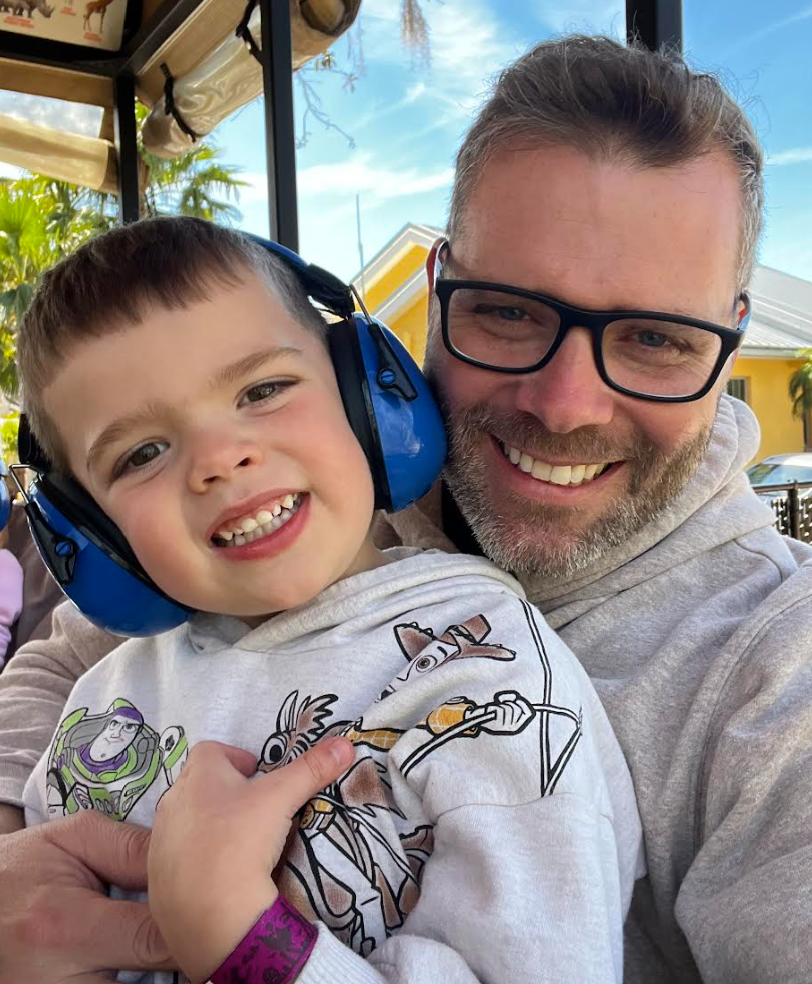
- Practice with ear defenders or headphones. Have your child wear them for short, pleasant stretches before the night so they feel familiar, not like an emergency.
- Set up a sound-buffered sleep space. Close windows and curtains, and use a fan or white noise machine to soften late pops. Pick the room farthest from the street.
- Tell your child what might happen. A simple line works: "People might set off fireworks tonight. They are loud, they are outside, and you are safe in bed." Scheerer's 2022 survey found that warning in advance was one of the most common things parents did to help.
- Plan the wake-up response. Decide ahead of time who goes in, what they say and where the headphones are, so a 12:01 AM boom gets a calm, practiced answer.
Enjoying this article?
Get practical tips and insights delivered to your inbox — no spam, ever.
Use a visual countdown for the whole day
A countdown to midnight is abstract. A picture schedule for the day is not. The National Clearinghouse on Autism Evidence and Practice's 2020 review lists visual supports as an evidence-based practice for autistic children, and December 31 is a good day to lean on them.
Show the day in order: breakfast, outing or quiet play, snack, the countdown with its own picture, dinner, bath, bed. When your child asks "when is the new year," you can point to the picture instead of explaining time zones. If your family used an Advent calendar as a visual countdown in December, the same idea carries straight into the last day of the year.
Keep January 1 ordinary
The best gift of New Year's Eve with an autistic child might be a boring New Year's morning. Keep wake time close to normal, serve the usual breakfast, and put a familiar activity first on the schedule. Pediatric sleep guidance generally says an occasional later bedtime is fine as long as the wake time stays steady and bedtime returns to normal within a night or two.
If the holidays have already pushed bedtime later, our post on autism and sleep problems covers how to bring it back gradually. A calm New Year's Eve with an autistic child is one where the countdown happened, everyone slept, and January 1 looks like a normal day.
VizyPlan was built by an autism dad and an autism mom who is a licensed speech-language pathologist so the countdown, the fireworks plan and the January 1 morning can all sit on one picture schedule your child already knows.
Download VizyPlan and start your 7-day free trial today. Put the countdown on the schedule before December 31 does. If it helps, keep going for $6.99/month or $59.99/year.
VizyPlan was built by an autism dad and an autism mom who is a licensed speech-language pathologist who needed something that did not exist. Start your free trial.