
December asks a child to wait for something huge without being able to see how far away it is. An advent calendar for an autistic child solves the part of the month that is actually hard, and it is not the treat behind the door. It is the count.
"How many more sleeps?" is not impatience. For a lot of autistic kids it is a genuine attempt to make an invisible stretch of time concrete, and the answer changes every time they ask.
Why a countdown matters more than the prize
Researchers have a name for the discomfort of not knowing what comes next: intolerance of uncertainty. A 2020 meta-analysis in the journal Autism pooled ten studies and found a strong association between intolerance of uncertainty and anxiety in autistic people. An earlier study suggested that intolerance of uncertainty helps explain why anxiety is so much more common in autistic children in the first place, and a widely cited meta-analysis found that about 40% of autistic children have at least one anxiety disorder.
December is uncertainty stacked on uncertainty. School winds down, the house changes, relatives arrive, and the biggest day of the year sits at the end of a month nobody can see. Visual supports are one of the tools with the strongest backing here: the National Clearinghouse on Autism Evidence and Practice classifies them as an evidence-based practice for autistic children and youth. An advent calendar for an autistic child is simply a visual support pointed at time.
Build an advent calendar for an autistic child that fits your family
The word advent belongs to Christmas, but the idea does not. The same countdown works for the eight nights of Hanukkah, the seven days of Kwanzaa from December 26, or plainly "days until winter break." Some families run two: one to the last day of school and one to the holiday itself.
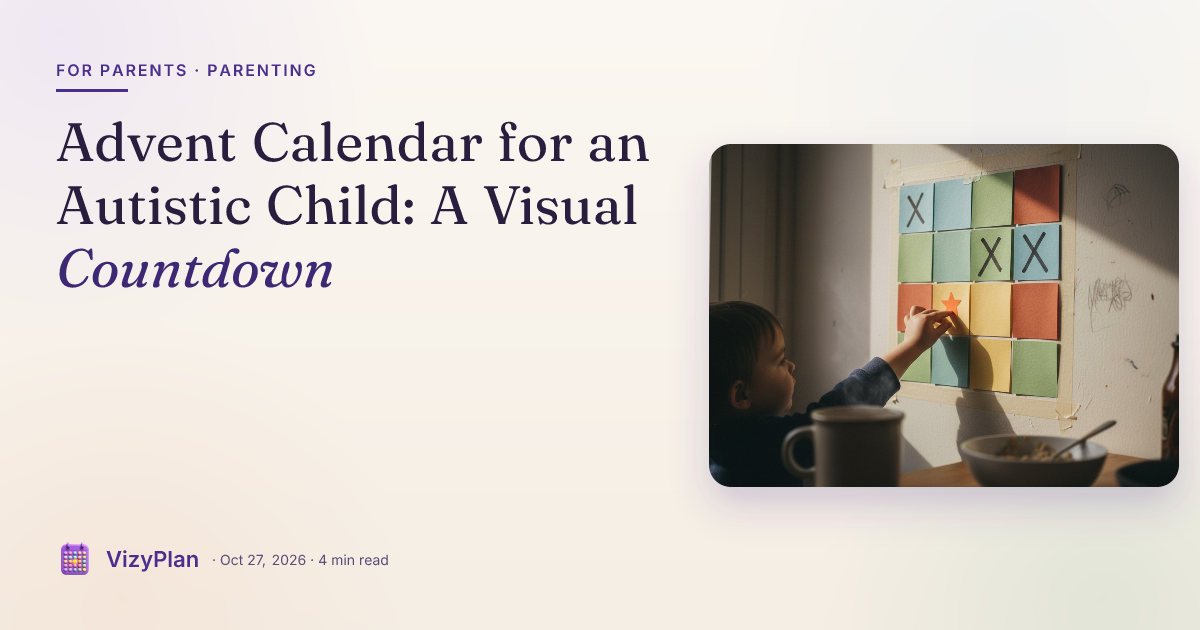
- Start on December 1 and show the whole month at once. A strip or grid where every day is visible from the start beats a box of closed doors, because the end point never moves.
- Make the finished days obvious. A sticker, a cross, or a flipped card. The point is that your child can count what is left without asking you.
- Mark the big days in a different color. The last school day, the travel day, the night guests arrive. Seeing them coming is what takes the edge off when they land.
- Skip the surprise if surprises are hard. Some kids love a mystery behind a door. Plenty find it stressful. Label every pocket in advance, or put the same small thing in each one.
- Swap candy for something calmer. A sticker, a picture of tomorrow's plan, a favorite song, ten minutes of a preferred activity, or a page of a holiday story. A non-candy calendar also keeps sugar out of bedtime.
- Keep the opening at the same time each day. After breakfast or before bed, never both. The ritual becomes its own anchor.
- Plan for the day after. A countdown that ends on the holiday leaves a blank week. Add a few squares past it so the calendar ends on a normal day.
Enjoying this article?
Get practical tips and insights delivered to your inbox — no spam, ever.
When the calendar becomes the stress
An advent calendar for an autistic child can tip from helpful to stressful. If your child starts fixating on tomorrow's square or melting down over a pocket opened early, that is information, not failure. Simplify it: fewer squares, no contents at all, just the count. For some kids the most regulating version is a plain row of numbers that only ever gets shorter.
The same thinking helps with the decorations going up around the house, which our guide to holiday decorations and autism covers, and with the long stretch after school ends, which is where a winter break schedule picks up. If a visual plan is new for your family, start with our overview of visual schedules for autism.
An advent calendar for an autistic child does not need to be beautiful or bought. It needs to answer "how many more days?" before anyone has to ask.
VizyPlan was built by an autism dad and an autism mom who is a licensed speech-language pathologist so the countdown, the last school day and the holiday itself can be a picture plan your child checks on their own.
Download VizyPlan and start your 7-day free trial today. Show December before it happens. If it helps, keep going for $6.99/month or $59.99/year.
VizyPlan was built by an autism dad and an autism mom who is a licensed speech-language pathologist who needed something that did not exist. Start your free trial.