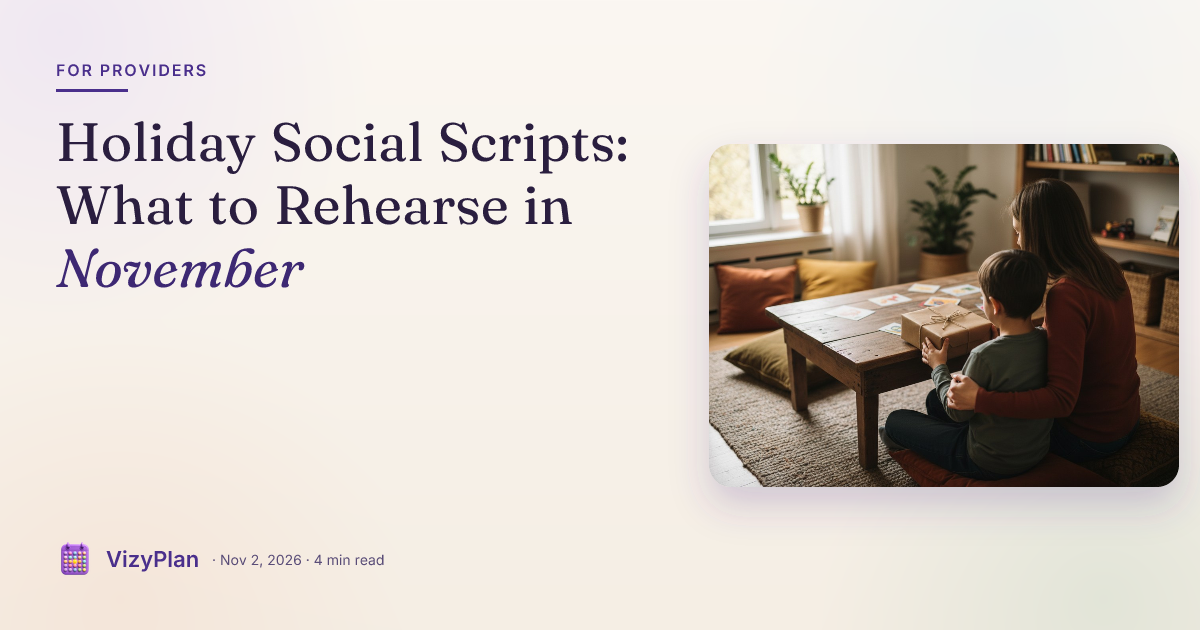

Every December a family hands a therapist a gift bag at the end of a session, and the therapist has about three seconds to decide what to do with it. Accepting gifts from clients is one of the few ethics questions that arrives wrapped in tissue paper, in front of a child, with a parent watching your face.
The answer is easier when it was decided in October. The codes are more specific than most clinicians remember, and they differ by discipline.
What the codes actually say about accepting gifts from clients
Behavior analysts. The BACB Ethics Code for Behavior Analysts, Standard 1.12, is the only one of the three with a dollar figure. Behavior analysts do not give gifts to or accept gifts from clients, stakeholders, supervisees or trainees with a monetary value of more than $10 US dollars. The same standard says a gift is acceptable if it is an infrequent expression of gratitude with no financial benefit, warns that ongoing or cumulative gifts can become a violation even when each one is small, and requires behavior analysts to tell clients and stakeholders about the rule at the start of the professional relationship. RBTs work under the separate RBT Ethics Code, so confirm its gift language with your supervising BCBA.
Speech-language pathologists. The ASHA Code of Ethics has no dollar limit. ASHA's Issues in Ethics statement on conflicts of professional interest, which builds on Principle III, Rule B, names gifts from clients and their relatives as a source of conflict and says professionals should not accept gifts or benefits unless they can clearly show the gift primarily contributes to the welfare of the people they serve.
Occupational therapy practitioners. The AOTA 2025 Occupational Therapy Code of Ethics, Standard 2G, says not to accept gifts that would unduly influence the therapeutic relationship or have the potential to blur professional boundaries, and to follow employer and state policies when offered gifts.
Notice what all three share: the concern with accepting gifts from clients is influence and boundaries, not the cookies. Your employer's policy and your state rules sit on top of each code, and the stricter one wins.
The other direction: gifts from the clinic
Holiday gifts often flow both ways. For families covered by Medicare or Medicaid, the HHS Office of Inspector General's 2016 policy statement on nominal value allows provider gifts of no more than $15 per item and $75 in total per patient per year, and never cash or cash equivalents like gift cards. If your practice bills Medicaid, run the holiday gift plan past whoever handles compliance.
Enjoying this article?
Get practical tips and insights delivered to your inbox — no spam, ever.
How to write a clinic holiday gift policy
A written policy on accepting gifts from clients takes one staff meeting and saves a dozen awkward doorways.
- Start from the strictest code on your team. A mixed clinic of SLPs, OTs and BCBAs should write one policy that satisfies the BACB $10 limit, so nobody is following a different rule in the same hallway.
- Name what is welcome. Cards, drawings, notes and a shared treat for the whole team give families a yes to reach for instead of only a no.
- Name what goes back. Cash, gift cards and anything over your limit are declined, every time, for every clinician.
- Decide what happens to a gift that cannot be returned in the moment. Shared with the team, donated, or returned later with a note. A written default saves a clinician from improvising in the waiting room.
- Put it in intake paperwork and say it again in November. The BACB already requires behavior analysts to share the rule at the start of services. A short reminder before the holidays reaches families who signed intake forms two years ago.
- Document exceptions. If a gift is accepted or declined in an unusual situation, a one line note protects both the family and the clinician.
How to decline without hurting anyone
Families give gifts because the work mattered to them, and that deserves a warm response. Try: "This is so thoughtful, and I am not able to accept it because of our ethics rules. What I would love is a drawing for my wall." The drawing is usually the gift anyway.
Telling families in advance is what makes accepting gifts from clients a non-event. A note in the November newsletter that says thank you, explains the limit in one sentence and suggests a drawing turns an awkward moment into a craft. It pairs well with the holiday break regression plan you are already sending home, and the same coaching tone from the first six weeks of parent coaching works here too.
VizyPlan was built by an autism dad and an autism mom who is a licensed speech-language pathologist so the routines a family practiced with you all fall can keep going through the weeks your sessions pause.
Share VizyPlan with your families so the holiday break keeps the routines you built together. The 7-day free trial lets a family try it first. If it helps, keep going for $6.99/month or $59.99/year.
VizyPlan was built by an autism dad and an autism mom who is a licensed speech-language pathologist who needed something that did not exist. Explore VizyPlan.