
Vizy Timer

A Sensory Break at School that has a way back in.

Your child has a break pass, and either they never use it or they use it and do not come back. Both problems have the same root, which is that nobody defined how long a break lasts.

Free 7-day trial · No email or credit card to start · Built by an autism dad and a licensed SLP

Why it works here

Why a visual timer helps with a sensory break at school

A break without a defined length is not a break, it is an escape, and staff quickly start rationing it. A visible timer makes the return automatic, which protects the break for the student and makes the adults comfortable enough to keep offering it.

You will recognize this if

  • Staff have started questioning how often the break pass gets used.
  • Your child leaves the room and the return is negotiated every time.
  • Breaks only happen after escalation rather than before it.
What the research says

Visual supports signalling an upcoming change reduced the delay between an adult instruction and a student starting the next activity, compared with verbal prompts alone.

Dettmer, Simpson, Myles and Ganz, Focus on Autism and Other Developmental Disabilities, 2000
The setup

How to set it up for a sensory break at school

Takes about five minutes. Use it as written, or keep only the steps your family needs. A short setup that gets used beats a complete one that gets abandoned in week two.

  1. 1 Agree a fixed break length with the school and write it into the plan
  2. 2 Keep the timer in the break space rather than the classroom
  3. 3 Teach the child to start the timer themselves as the first step of the break
  4. 4 Name the return step, so coming back is a task rather than a decision
  5. 5 Use the same break space every time so the environment is predictable
  6. 6 Review the length after a two weeks rather than adjusting it in the moment
The mistake most families make

Using the break as a consequence after a difficult moment turns a regulation tool into a punishment. The point of a break is that it happens before it is needed.

In the app

Built into the routine, not bolted onto it.

The Vizy Timer lives inside the same routine your child already follows, so a sensory break at school is a step with a visible length rather than a separate tool somebody has to remember to open.
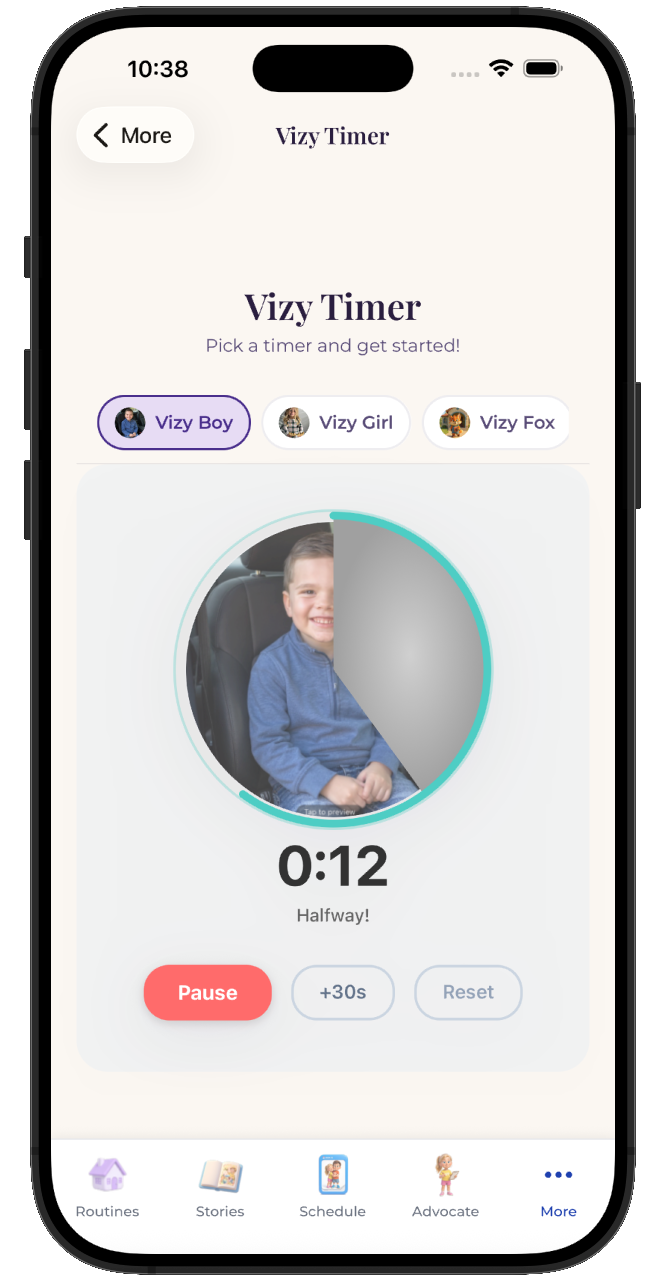
  • Attach it to any step in any routine
  • Works for pre-readers, gestalt language processors, and AAC users
  • Same setup at home, at school, and in therapy
See the step-by-step guide →
The VizyPlan Vizy Timer set up for a sensory break at school

Set this up for your child.

Five minutes to build, and your child sees it every time a sensory break at school comes around.

$6.99/month after the free trial · Cancel anytime · Also at app.vizyplan.com

Common questions

About a sensory break at school

How long should a school sensory break be?
Long enough to change the child's state and short enough that staff will keep honouring it, which in practice is often three to five minutes. Consistency matters more than generosity.
Can a break timer be written into an IEP?
Yes, and being specific helps. A break of a named length in a named place, initiated by the student, is far more likely to happen than a general reference to breaks as needed.
What if my child will not return when the timer ends?
That usually means the break is too short, the return step is unclear, or the classroom itself is the problem. All three are worth checking before treating it as non-compliance.

VizyPlan supports routines and communication at home and school. It is not a medical device and does not diagnose or treat any condition. Talk to your child's care team about clinical questions.