Vizy Timer

Getting a Haircut in a chair that finally has an end.

Clippers, a stranger, a cape around the neck, hair falling on skin, and a mirror showing all of it. A haircut asks a sensory-sensitive child to tolerate six difficult things at once while sitting still.

Free 7-day trial · No email or credit card to start · Built by an autism dad and a licensed SLP

Why it works here

Why a visual timer helps with getting a haircut

The distress in a haircut is driven as much by the unknown length as by the sensations. A visible timer tells your child exactly how long they have to hold on, and knowing the endpoint makes a difficult sensory experience into a survivable one.

You will recognize this if

  • Half your child's hair has been cut at home while they slept.
  • Your child copes for two minutes and then cannot continue.
  • The anticipation in the days before is worse than the appointment.
What the research says

In a survey of 86 autistic adults, 50 percent reported disliking haircuts, and higher tactile hypersensitivity was associated with wider difficulties in daily life.

Ferrer Knight and Birtles, Autism, 2025
The setup

How to set it up for getting a haircut

Takes about five minutes. Use it as written, or keep only the steps your family needs. A short setup that gets used beats a complete one that gets abandoned in week two.

  1. 1 Book the first or last slot, when the salon is quietest
  2. 2 Visit once without cutting anything so the room is not new
  3. 3 Agree a short timer for the first sitting, even if the cut is unfinished
  4. 4 Let your child hold the timer themselves throughout
  5. 5 Give the stylist the plan before you sit down, not during
  6. 6 Stop when the timer stops and book a second short visit rather than pushing on
The mistake most families make

Pushing through to finish the cut because you are already there is the single most common reason a child refuses the next appointment entirely.

In the app

Built into the routine, not bolted onto it.

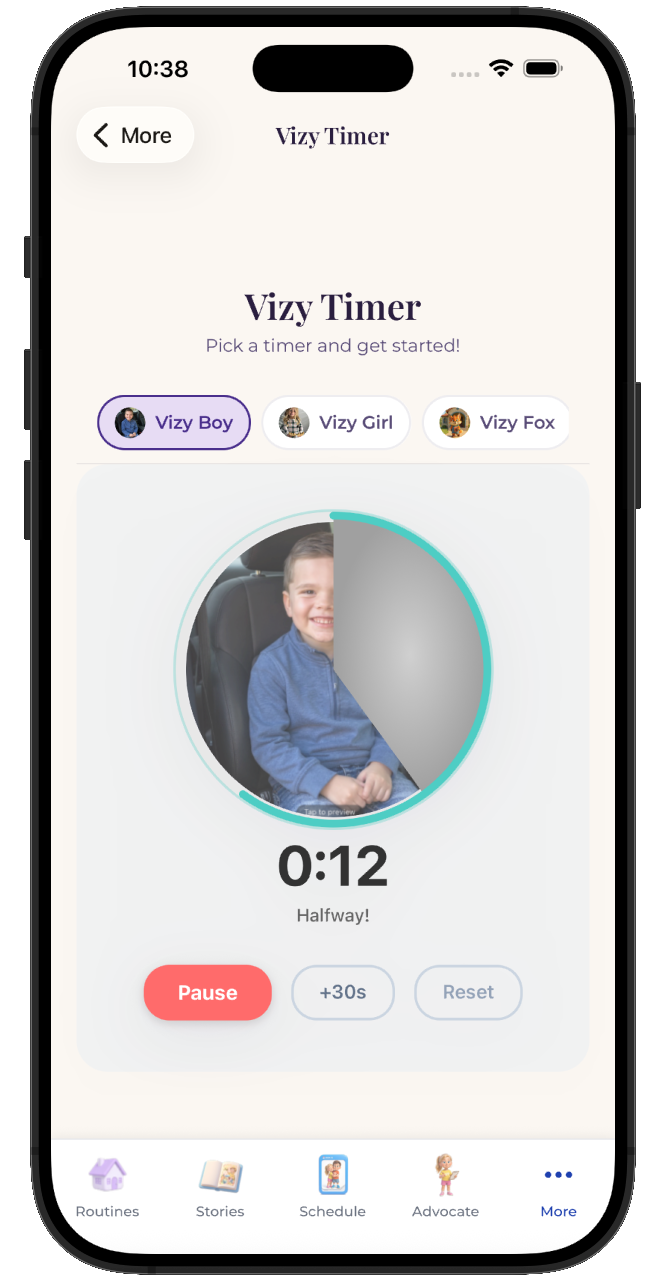
The Vizy Timer lives inside the same routine your child already follows, so getting a haircut is a step with a visible length rather than a separate tool somebody has to remember to open.
  • Attach it to any step in any routine
  • Works for pre-readers, gestalt language processors, and AAC users
  • Same setup at home, at school, and in therapy
See the step-by-step guide →
The VizyPlan Vizy Timer set up for getting a haircut

Set this up for your child.

Five minutes to build, and your child sees it every time getting a haircut comes around.

$6.99/month after the free trial · Cancel anytime · Also at app.vizyplan.com

Common questions

About getting a haircut

Should I look for a sensory-friendly barber?
If one exists nearby, yes, and it is worth travelling for. Failing that, most stylists will accommodate a quiet slot and a short first sitting if you ask in advance.
What about cutting hair at home?
Home has real advantages, a familiar room and no audience, and the same timer approach applies. The trade-off is that you become the person doing the difficult thing.
Is it worth showing photos beforehand?
Very much so. Photos of the actual salon, the actual chair, and the actual stylist remove several unknowns before your child walks in.

VizyPlan supports routines and communication at home and school. It is not a medical device and does not diagnose or treat any condition. Talk to your child's care team about clinical questions.