Visual Routines

Sharing a Routine With School so it does not stop at the gate.

Your child follows a clear routine at home and school has built a different one, with different words and different pictures, for the same skill.

Free 7-day trial · No email or credit card to start · Built by an autism dad and a licensed SLP

Why it works here

Why a visual routine helps with sharing a routine with school

A child running two versions of the same routine is learning two things instead of one. Sharing the actual artifact, rather than describing it, is what makes a support transfer between settings.

You will recognize this if

  • Skills hold at home and not at school, or the reverse.
  • School uses different vocabulary for the same daily activities.
  • Nobody has actually seen the other setting's version.
What the research says

Families consistently ask for greater communication and care coordination between health professionals and educators, and coordinated support is among the outcomes they value most.

Frontiers in Rehabilitation Sciences, 2024
The setup

How to set it up for sharing a routine with school

Takes about five minutes. Use it as written, or keep only the steps your family needs. A short setup that gets used beats a complete one that gets abandoned in week two.

  1. 1 Share the routine itself rather than a description of it
  2. 2 Ask what school currently uses for the same skill
  3. 3 Agree on one shared version rather than aligning everything
  4. 4 Match the words exactly, even where the pictures cannot match
  5. 5 Print it as cards if school cannot use the app
  6. 6 Review it at the next planned meeting rather than mid-term
The mistake most families make

Sending a long explanation instead of the artifact means nobody uses it. Teachers act on things they can pick up and run, not on paragraphs.

In the app

Built into the routine, not bolted onto it.

The Visual Routines lives inside the same routine your child already follows, so sharing a routine with school is a step with a visible length rather than a separate tool somebody has to remember to open.
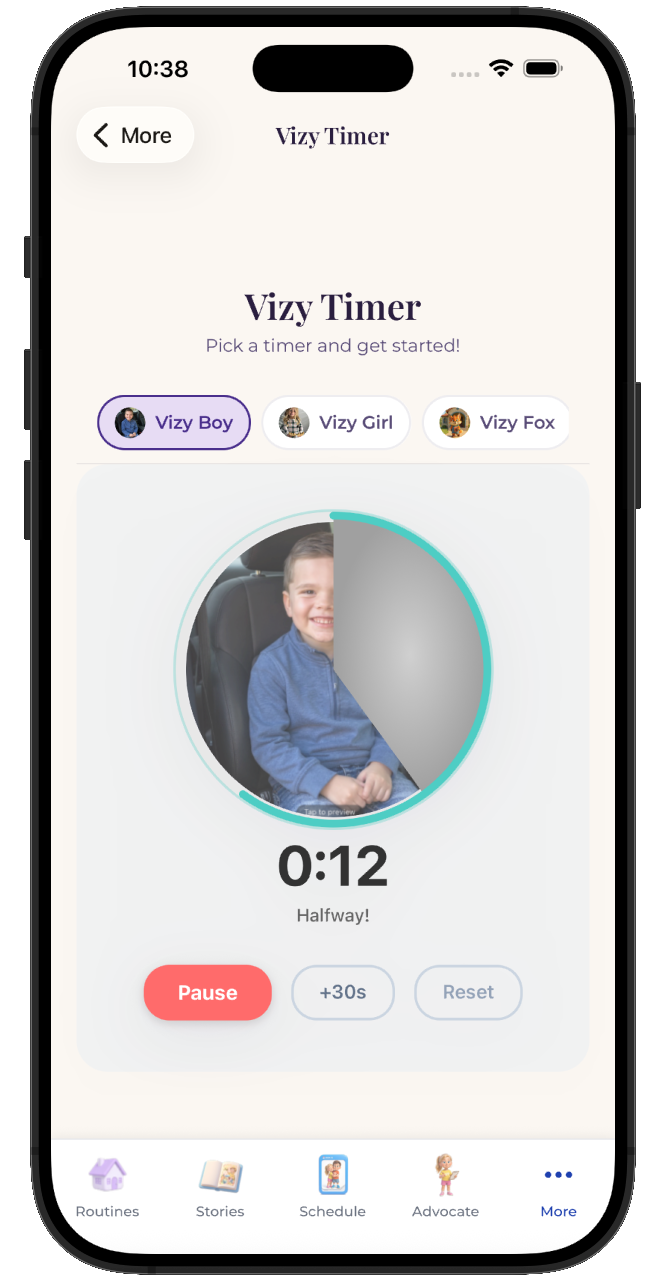
  • Attach it to any step in any routine
  • Works for pre-readers, gestalt language processors, and AAC users
  • Same setup at home, at school, and in therapy
See the step-by-step guide →
The VizyPlan Visual Routines set up for sharing a routine with school

Set this up for your child.

Five minutes to build, and your child sees it every time sharing a routine with school comes around.

$6.99/month after the free trial · Cancel anytime · Also at app.vizyplan.com

Common questions

About sharing a routine with school

Will school actually use it?
More often when it is short, concrete, and immediately usable. A one-page printed sequence gets used where a login and a tutorial usually do not.
Which routines are worth sharing?
The one or two that carry the most weight, usually a break request or a transition sequence. Aligning everything rarely survives contact with a real classroom.
What if school disagrees with our approach?
Ask what they are seeing, because the settings genuinely differ. Aligning on one shared target beats arguing about the whole plan.

VizyPlan supports routines and communication at home and school. It is not a medical device and does not diagnose or treat any condition. Talk to your child's care team about clinical questions.