

Visual Routines

Building a Toileting Routine that does not wait for a signal.

Sit until something happens is an instruction with no visible end, given to a child who may not reliably feel the signal in the first place.

Free 7-day trial · No email or credit card to start · Built by an autism dad and a licensed SLP

Why it works here

Why a visual routine helps with building a toileting routine

Scheduled toileting works better than waiting for interoceptive awareness that arrives late or faintly. A fixed routine at fixed times removes both the guessing and the open-ended sitting that turns toileting into avoidance.

You will recognize this if

  • Your child resists sitting rather than resisting the toilet.
  • Accidents follow a refused or skipped sit.
  • Your child does not seem to notice the signal until it is urgent.
What the research says

A comparison of 40 autistic children with 43 age-matched controls found daytime wetting in 45 percent of the autistic group against 4.7 percent of controls.

von Gontard et al., Journal of Pediatric Urology, 2015
The setup

How to set it up for building a toileting routine

Takes about five minutes. Use it as written, or keep only the steps your family needs. A short setup that gets used beats a complete one that gets abandoned in week two.

  1. 1 Schedule sits at fixed points anchored to existing routines
  2. 2 Keep the sit short and let time rather than outcome end it
  3. 3 Write the full sequence as steps, including handwashing and returning
  4. 4 Let your child start the routine themselves
  5. 5 End when the routine ends, regardless of whether anything happened
  6. 6 Keep the bathroom, the order, and the timing identical
The mistake most families make

Extending a sit because you think something is about to happen turns a predictable routine back into an open-ended one, which is the fastest route to refusal.

In the app

Built into the routine, not bolted onto it.

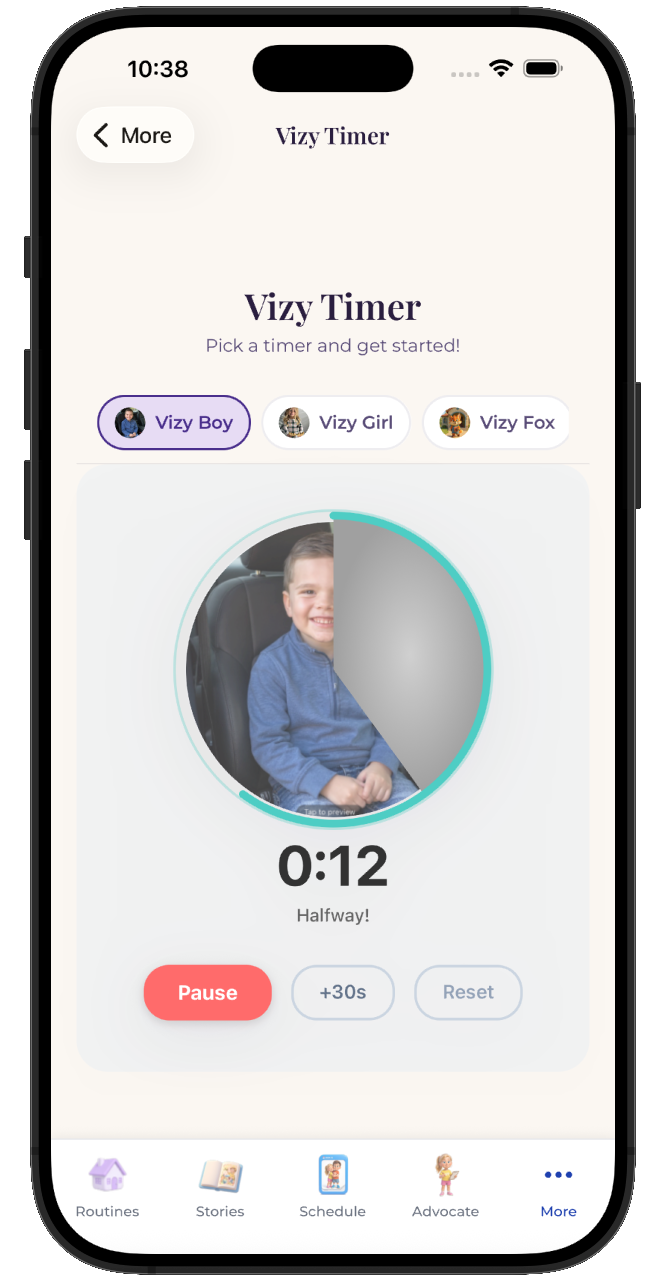
The Visual Routines lives inside the same routine your child already follows, so building a toileting routine is a step with a visible length rather than a separate tool somebody has to remember to open.
  • Attach it to any step in any routine
  • Works for pre-readers, gestalt language processors, and AAC users
  • Same setup at home, at school, and in therapy
See the step-by-step guide →
The VizyPlan Visual Routines set up for building a toileting routine

Set this up for your child.

Five minutes to build, and your child sees it every time building a toileting routine comes around.

$6.99/month after the free trial · Cancel anytime · Also at app.vizyplan.com

Common questions

About building a toileting routine

How long should a sit be?
Short enough that your child will do it willingly, often three to five minutes. Several short tolerated sits beat one long resisted one.
Should I rule out anything medical?
Yes, early. Constipation is common, easily missed, and produces exactly this pattern, so it is worth a conversation with your pediatrician.
What if nothing happens?
End the routine and say nothing about the outcome. The habit you are building is the sitting, and pressure on results undermines it.

VizyPlan supports routines and communication at home and school. It is not a medical device and does not diagnose or treat any condition. Talk to your child's care team about clinical questions.