
Visual Routines

How Many Steps a Routine Should Have before it collapses under its own weight.

Your morning routine started with five steps and now has nineteen, because every time something went wrong you added a step. Nobody has ever removed one.

Free 7-day trial · No email or credit card to start · Built by an autism dad and a licensed SLP

Why it works here

Why a visual routine helps with how many steps a routine should have

Routines fail at a fairly predictable length, and the failure looks like disengagement rather than difficulty. Keeping a routine short enough to finish is what produces the daily completion that turns a sequence into a habit.

You will recognize this if

  • Your child completes the first half and drifts on the second.
  • The routine is noticeably longer than when you built it.
  • You find yourself skipping steps to get through it.
What the research says

Visual activity schedules qualify as an evidence-based practice across 31 reviewed studies, with the mechanism resting on a child being able to follow the sequence independently rather than on its completeness.

Knight, Sartini and Spriggs, Journal of Autism and Developmental Disorders, 2015
The setup

How to set it up for deciding how many steps a routine should have

Takes about five minutes. Use it as written, or keep only the steps your family needs. A short setup that gets used beats a complete one that gets abandoned in week two.

  1. 1 Count the steps in your current routine and write the number down
  2. 2 Cut anything your child now does automatically without looking
  3. 3 Aim for five to eight steps in a routine a child runs independently
  4. 4 Split a long routine into two shorter ones with a natural break between
  5. 5 Add a step only by removing another one
  6. 6 Recount every month, because routines grow when nobody is watching
The mistake most families make

Adding a step every time something goes wrong is how a five-minute routine becomes a twenty-minute one that nobody finishes. The subtraction has to be scheduled or it never happens.

In the app

Built into the routine, not bolted onto it.

The Visual Routines lives inside the same routine your child already follows, so deciding how many steps a routine should have is a step with a visible length rather than a separate tool somebody has to remember to open.
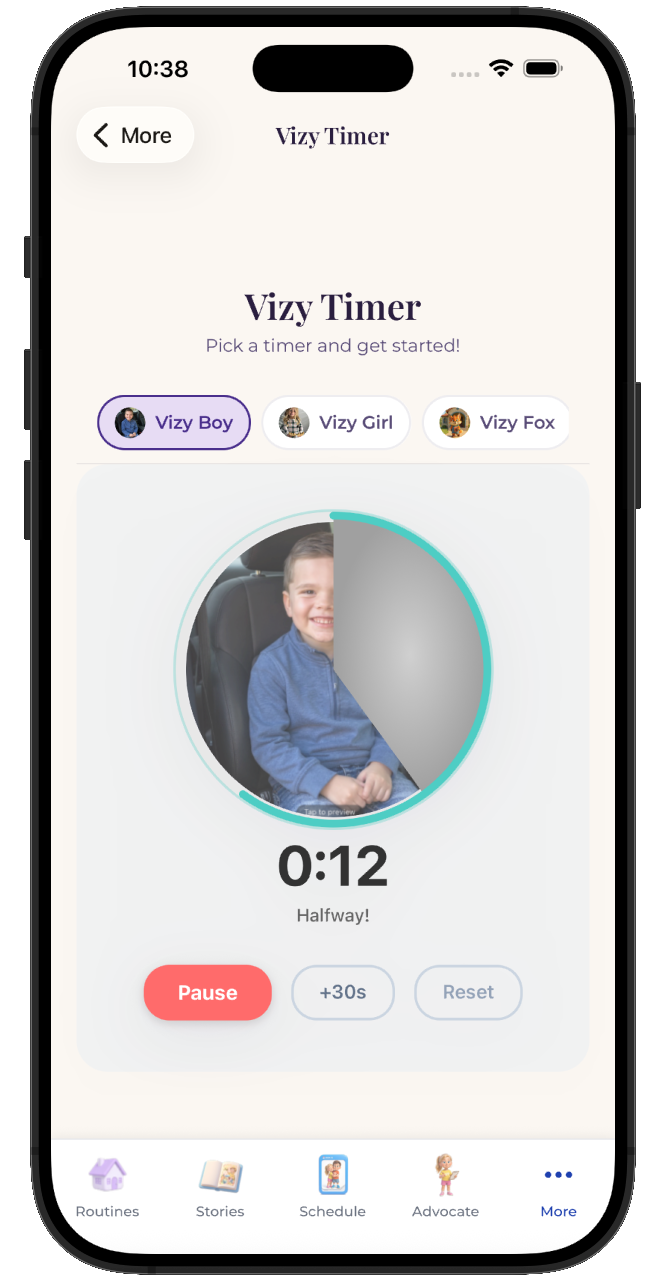
  • Attach it to any step in any routine
  • Works for pre-readers, gestalt language processors, and AAC users
  • Same setup at home, at school, and in therapy
See the step-by-step guide →
The VizyPlan Visual Routines set up for deciding how many steps a routine should have

Set this up for your child.

Five minutes to build, and your child sees it every time deciding how many steps a routine should have comes around.

$6.99/month after the free trial · Cancel anytime · Also at app.vizyplan.com

Common questions

About deciding how many steps a routine should have

What is the right number of steps?
Five to eight for most independent routines, fewer for younger children and for anything new. The test is whether your child finishes it without support, not whether it covers everything.
What if the routine genuinely needs more steps?
Split it into two routines with a break between them. Two short sequences are far easier to complete than one long one.
How do I know which steps to cut?
Watch which ones your child does without looking at the routine. Those have moved into habit and no longer need to be on it.

VizyPlan supports routines and communication at home and school. It is not a medical device and does not diagnose or treat any condition. Talk to your child's care team about clinical questions.