

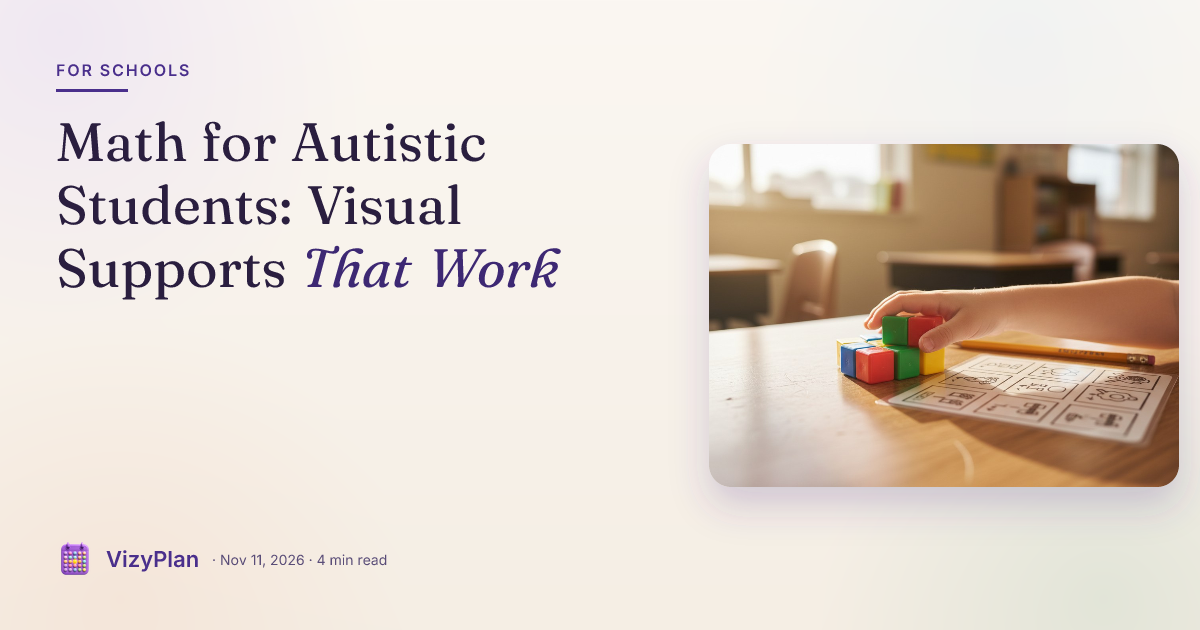
Math for autistic students often breaks down in a predictable place. A student who can rattle off multiplication facts freezes at a two-sentence word problem, or a student who loves numbers melts down when the worksheet looks different from yesterday. The math itself is rarely the whole problem. The hidden steps are.
Visual supports make those hidden steps visible. A picture of the problem type, a drawing before the equation and a step card on the desk turn a wall of words into a path your students can follow. The good news for K-8 teachers and special educators is that the research behind these tools is strong, and most of them cost nothing.
What the research says about math for autistic students
The National Clearinghouse on Autism Evidence and Practice reviewed 972 studies for its 2020 report and named 28 evidence-based practices. Visual supports and task analysis, which means breaking a skill into small, teachable steps, are both on the list. The report also found studies targeting academic skills nearly doubled, from 55 in 1990 to 2011 to 96 in 2012 to 2017.
The What Works Clearinghouse practice guide Assisting Students Struggling with Mathematics (2021), chaired by Lynn Fuchs, rated all six of its recommendations as strong evidence. Two matter most here. Recommendation 3 calls for a well-chosen set of concrete and semi-concrete representations. Recommendation 5 calls for deliberate word problem instruction: teach one problem type at a time, such as Change, Combine or Compare problems, and give students a visual guide of the steps that you fade over time.
Studies focused on math for autistic students point the same way. Root, Browder, Saunders and Lo, writing in Remedial and Special Education (2017), used modified schema-based instruction with three elementary students with autism and moderate intellectual disability and found a functional relation between the instruction and word problem solving. All three students kept their gains, and all three preferred the virtual manipulatives over the physical ones once they had a choice.
Schema-based instruction: teach the problem type, not the keyword
Keyword tricks like "altogether means add" fail fast, and math for autistic students is no exception. The WWC guide warns that a problem type is different from an operation, since the same type can call for different operations. Schema-based instruction teaches students to recognize the structure of the story first.
A Change problem has a start, a change and an end. A Combine problem has parts and a whole. Give each type its own simple diagram, and have students sort problems by type before they solve anything. For many autistic learners, a predictable diagram for each problem type is a relief, because the same visual shows up every time.
The CRA sequence: concrete, then drawn, then abstract
The concrete-representational-abstract sequence, a staple of math for autistic students, moves from objects students can touch, to drawings, to numbers and symbols. The WWC guide describes concrete tools like base ten blocks and fraction tiles, and semi-concrete tools like strip diagrams, tally marks and number lines.
In a 2023 single-case study in the International Journal of Developmental Disabilities, Kaya and Guner Yildiz used CRA with a seven-year-old autistic student in a general education first-grade class. The student learned basic addition, subtraction and tens-and-ones, kept those skills two to four weeks later, and used them with another person in another setting.
Enjoying this article?
Get practical tips and insights delivered to your inbox — no spam, ever.
Worked examples and visual step cards
A worked example is a fully solved problem a student can study before trying one alone. The WWC guide models a teacher thinking aloud through each step, then solving the next example with students explaining each step back.
In math for autistic students, pair worked examples with a visual step card. The WWC guide suggests steps such as "read the problem," "name the problem type," "identify the question" and "find relevant information." A step card is task analysis on paper, and the same idea powers the visual sequences OTs use for executive function.
A teacher plan for math for autistic students
- Pick one problem type. Start with Change or Combine. Teach that single type until students recognize the type reliably before adding another.
- Tell the story with every number filled in. The WWC guide recommends showing a complete story first so students think about what the quantities mean, then removing one number to make the word problem.
- Act the problem out with objects. Counters, cubes or students themselves. Concrete first, every time a new skill starts.
- Move to a drawing. Use the same diagram for the same problem type: a part-part-whole box, a strip diagram or a number line.
- Model a worked example out loud. Narrate each decision, then solve a second example together with students explaining the steps.
- Put a step card on the desk. Four to six steps, one picture or icon per step, in the same order every day. Keep the card consistent across math centers and small groups.
- Fade the supports on purpose. Remove one step picture at a time as accuracy holds, and bring the card back when a new problem type arrives.
- Mix old problem types back in. Once a type is mastered, place the type alongside new ones so students keep sorting by structure.
Write the step card into the plan your team already uses. Our guide to IEP accommodations in the first week covers making supports like these official, and our teacher's starter guide to visual schedules uses the same picture-per-step logic for the rest of the day.
VizyPlan was built by an autism dad and an autism mom who is a licensed speech-language pathologist, so the step-by-step visuals a student follows at school can look the same at the kitchen table during homework.
Share VizyPlan with your families so the math step card from class carries over to homework time. The 7-day free trial lets a family try it first. If it helps, keep going for $6.99/month or $59.99/year.
VizyPlan was built by an autism dad and an autism mom who is a licensed speech-language pathologist who needed something that did not exist. Explore VizyPlan.