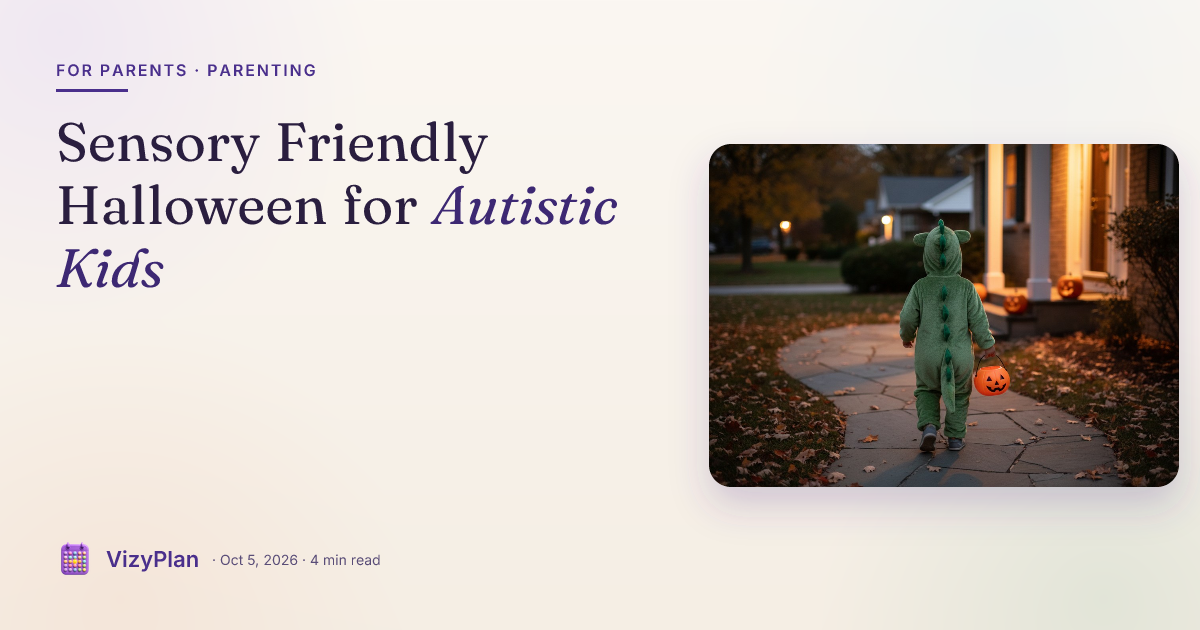
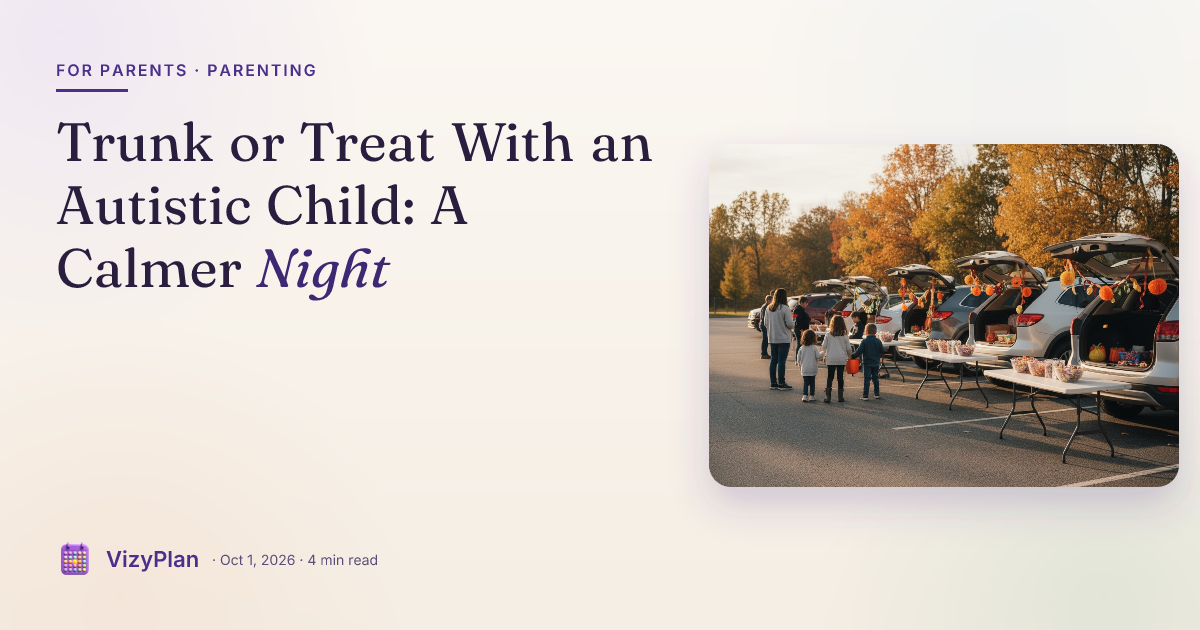
Nobody needs permission to do Halloween differently, but a lot of families are waiting for it anyway. Trunk or treat with an autistic child is not the consolation version of the holiday. It is the version that deletes most of the specific things that end the night early.
Count what the street actually asks of a child: unfamiliar stairs in the dark, a stranger's doorway, a dog behind that door, a route with no visible end, and a walk home that happens when everyone is already finished. A parking lot removes four of those five before anyone puts on a costume.
Why trunk or treat with an autistic child works
The structure is the point. Cars are parked in a fixed perimeter, so the whole event is visible from anywhere inside it. There are no steps and no thresholds to cross, which removes both the physical demand and the "am I allowed in" ambiguity. Most events run in daylight or early evening, so the dark is doing none of the work. The grown-ups handing out candy are standing in the open rather than appearing suddenly behind an opening door. Your car is usually right there, which converts the exit from a negotiation into a short walk.
The trade is crowding. A parking lot concentrates people, and for a child whose hardest input is other children at close range, that can be worse than a quiet street. Knowing which of those two your child finds harder is the whole decision.
- Go in the first fifteen minutes. The lot is half full, the line at each trunk is short, and the volume has not peaked.
- Walk the perimeter once before collecting anything. A lap with no demand turns an unknown space into a map.
- Pick your exit landmark out loud. Name the car, point at it, and check that your child can see it from the middle of the lot.
- Set the number before you start. Six trunks, then home. A countable target beats an open-ended lap every time.
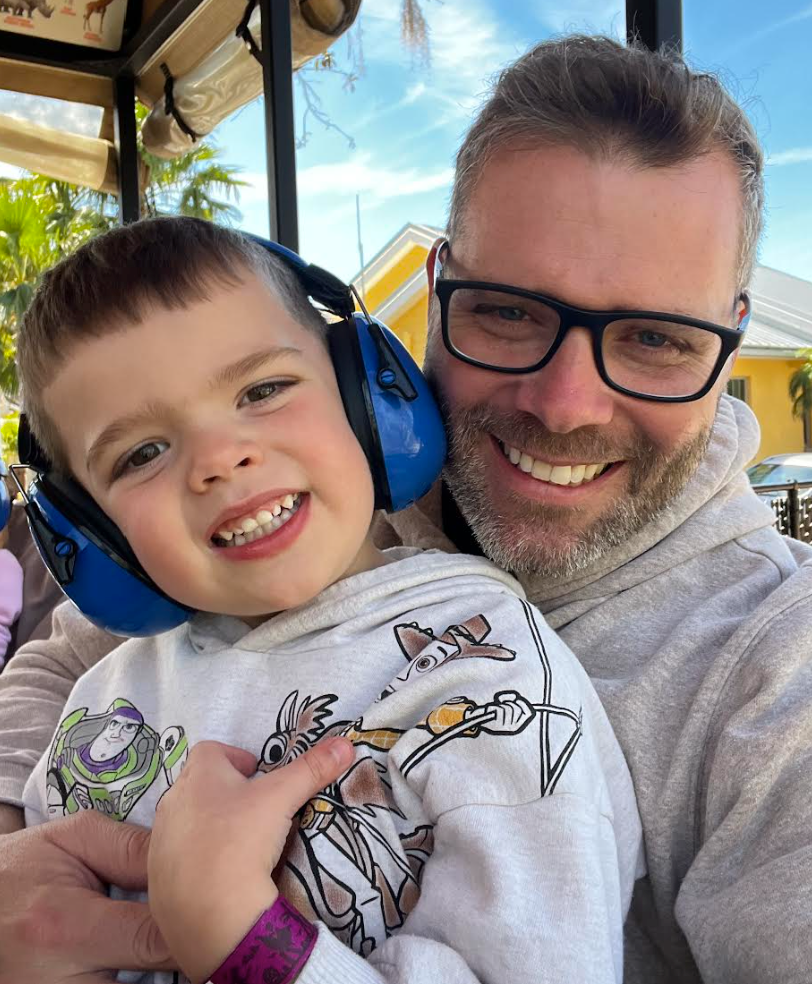
- Bring the headphones and use them early. Putting them on before the overload rather than after it is what keeps the evening going.
- Leave with candy still uncollected. Walking away while it is still fun is what makes next year possible, which is the same rule that governs a pumpkin patch and every other outing worth repeating.
The other versions that count
Libraries, museums and malls run daytime Halloween events with lights up and volume down, and they are often advertised as sensory-friendly specifically. Handing out candy from your own porch gives a child a fixed position, a clear job, and the social script on repeat. A costume parade in the living room for grandparents on video is a real Halloween for a kid who is not going outside this year.
A night that ends with your child wanting to do it again next year is a successful Halloween, whatever shape it took. The flyer version is not the standard, and nobody is grading you against it.
If you are going the traditional route this year, our sensory friendly Halloween plan covers the route, the costume and the blue bucket question.
VizyPlan was built by an autism dad and an autism mom who is a licensed speech-language pathologist so the six trunks and the walk back to the car can be a routine your child sees before you leave the house.
Enjoying this article?
Get practical tips and insights delivered to your inbox — no spam, ever.
Download VizyPlan and start your 7-day free trial today. Show the night before the night. If it helps, keep going for $6.99/month or $59.99/year.
VizyPlan was built by an autism dad and an autism mom who is a licensed speech-language pathologist who needed something that did not exist. Start your free trial.