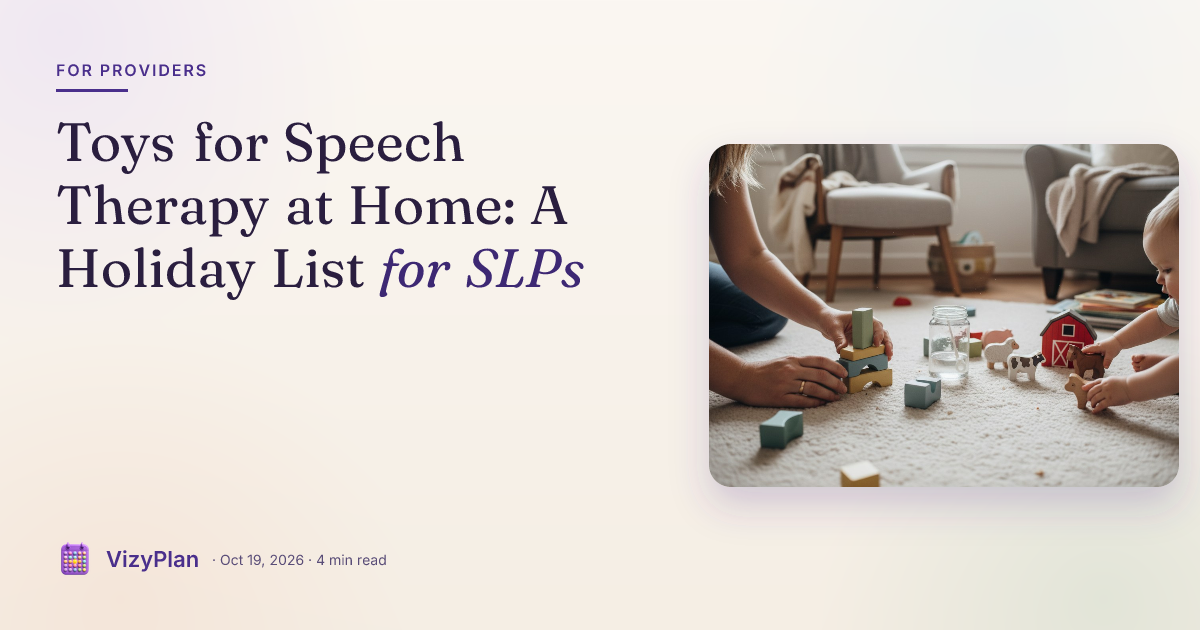
Sometime in the next six weeks, a parent will stop at the door after a session and ask what to buy for the holidays. Families want the gift to help, and the toy aisle is full of boxes promising to teach words. The most useful toys for speech therapy at home are usually the plainest ones on the shelf, and the most useful part of the answer is how the family plays with them.
Why simple toys beat talking toys
In Sosa's 2016 JAMA Pediatrics study, 26 parents and infants aged 10 to 16 months played with electronic toys, traditional toys and board books. During electronic toy play, parents used fewer words, took fewer conversational turns and responded less to their babies, and the babies vocalized less than during book reading. The sample was small, so treat the finding as a caution rather than a rule. The pattern still matches what many SLPs see: when the toy does the talking, the adult goes quiet. A bin of blocks has no script, so the adult and child have to write one together.
Toys for speech therapy at home, by skill
ASHA's holiday gift list, built from SLP recommendations, leans on classics. Grouped by skill, the list looks like this:
- Requesting and turn-taking: bubbles, wind-up toys, a ball ramp, pop-up toys. Each one stops and needs an adult to restart it, a natural reason to ask.
- Vocabulary and pretend play: play food and dishes, a baby doll with accessories, a farm with animals, a small dollhouse, a doctor kit.
- Concepts and sequencing: stacking blocks, shape sorters, simple puzzles, play dough with tools.
- Shared attention: durable board books and puppets, where the adult's face and voice are part of the toy.
ASHA also reminds families to check age labels for choking hazards and to choose books in every language the child is learning.
Coach the play, not the purchase
A meta-analysis by Roberts and Kaiser of 18 studies found that parent-implemented language interventions had positive effects on child language outcomes for children aged 18 to 60 months with language impairments, compared with no treatment. The strategies parents learn in approaches like Enhanced Milieu Teaching include arranging the environment, responding to the child, modeling target words and expanding what the child says.
Families do not need the clinical terms. They need a short script to go with the gift:
- Get down to the child's level. Sit on the floor, face to face, so the child can see the adult's mouth and expression during play.
- Follow the child's lead. Play with what the child chooses, in the way the child chooses.
- Comment instead of quizzing. "The cow is eating" invites talk. "What does the cow say?" feels like a test.
- Expand by one or two words. If the child says "car," the adult says "blue car" or "car goes fast."
- Offer choices. Hold up two snacks for the play kitchen or two colors of play dough, and wait for a word, sign, point or symbol.
- Wait longer than feels natural. Count silently to five or ten after a pause.
- Keep it short and daily. Ten minutes of floor play in an ordinary routine adds up faster than one long weekend session.
Our guide to the first six weeks of parent coaching covers teaching one strategy at a time.
Enjoying this article?
Get practical tips and insights delivered to your inbox — no spam, ever.
Make the play AAC-friendly
For kids on your caseload who use AAC, picking the right toy matters less than whether the device comes to the floor. The ASHA Practice Portal on AAC describes augmented input, where the partner pairs spoken words with AAC symbols, and notes that AAC use may help improve natural speech within a multimodal approach. For a family, that means modeling words like "more," "go," "stop" and "again" on the device during bubbles or a ball ramp, without requiring the child to press them.
A printed core board taped near the toy bin covers the times the device is charging. Our post on AAC and visual schedules at home has more ideas for carryover.
A list families can actually use
A one-page handout with five toys and three strategies beats a long gift guide. Pair it with your holiday break regression plan, and the new toys help keep language going over the break. The speech therapy carryover gap is exactly where toys for speech therapy at home do their best work.
VizyPlan was built by an autism dad and an autism mom who is a licensed speech-language pathologist so floor time with the new toys can be a picture step in a family's daily routine.
Share VizyPlan with your families so the holiday toys turn into daily practice. Families can try it free for a week. If it helps, they can keep going for $6.99/month or $59.99/year.
VizyPlan was built by an autism dad and an autism mom who is a licensed speech-language pathologist who needed something that did not exist. Explore VizyPlan.