
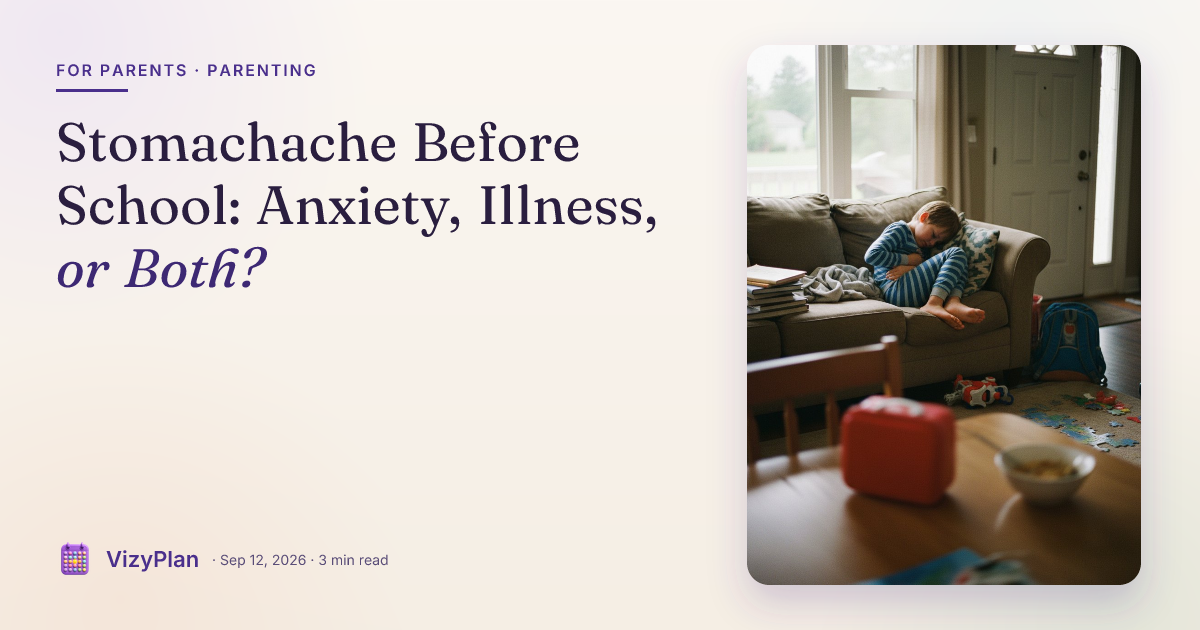
It is 7:15, the backpack is by the door, and here it comes: my tummy hurts. Again. You cannot tell whether to reach for the thermometer or the car keys, and neither can your child. A stomachache before school is one of the most common September problems in autism families, and the honest answer to "what is it" is usually: possibly both.
Why the two get tangled
Autistic children genuinely have more stomach trouble. A meta-analysis in Pediatrics of 15 studies found significantly higher rates of gastrointestinal symptoms in autistic children than in peers. They also carry more anxiety: a meta-analysis of 31 studies found roughly 40 percent of autistic youth have at least one anxiety disorder. The two feed each other. In a study of nearly 3,000 autistic children, chronic gut problems were significantly linked to higher anxiety and sensory over-responsivity. Add interoception, the sense that reads signals from inside the body and one many autistic kids find hard to read, and "my tummy hurts" can mean pain, worry, hunger, or a full bladder.
Guessing wrong costs something either way. A long-term study in Pediatrics followed children with functional abdominal pain: 51 percent later had an anxiety disorder, versus 20 percent of peers. A stomachache dismissed as nerves still deserves attention.
How to sort out a stomachache before school
- Track the calendar first. The American Academy of Pediatrics notes that school-avoidance stomachaches show up on school mornings and vanish on weekends. Two weeks of dates tells you more than any single morning.
- Rule out the body with your pediatrician. Fever, vomiting, weight loss, pain that wakes them at night, or pain in one spot all warrant a visit, and the AAP recommends a medical exam before assuming anxiety.
- Ask about the day, not the tummy. What is first today? Who do you sit with at lunch? A stomachache that spikes before gym or the bus is telling you where the worry lives.
- Give the body words. A picture scale: hurts, worried, hungry, do not know. Kids who cannot read internal signals do better choosing from pictures than answering open questions. Our post on interoception goes deeper.
- Keep the morning predictable either way. Anxiety lives in uncertainty. A visible morning routine cuts the unknowns between waking up and the bus. If mornings have become a standoff, school refusal in week three covers what to do next.
"Both" is an answer. A real stomach problem worth a doctor's visit and a real worry worth a plan can live in the same seven-year-old. Treat the body and the calendar together, and the mornings get shorter.
VizyPlan was built by an autism dad and a licensed speech-language pathologist so the morning has fewer unknowns for a child whose body is already carrying enough.
Enjoying this article?
Get practical tips and insights delivered to your inbox — no spam, ever.
Download VizyPlan and start your 7-day free trial today. Take the guesswork out of the hour before the bus. Just $6.99/month after your trial, no credit card required upfront.
VizyPlan was built by an autism dad and a licensed speech-language pathologist who needed something that did not exist. Start your free trial.