
A field trip is the day school stops being a room. For an autistic student it can also be the day the supports quietly disappear: the visual schedule stays on the wall, the aide is stretched across a bus, and the plan is "we will see how it goes." Field trips for autistic students work, but only when the trip is planned as part of the curriculum rather than a break from it.
The law has no field trip exception
Under IDEA, 34 CFR 300.107 requires schools to provide the supplementary aids and services a student with a disability needs for an equal opportunity in nonacademic activities. The Office for Civil Rights has applied that to trips. In a 2016 resolution, OCR found that requiring a parent to chaperone a student with a disability, when no other parent had to, denied that student an equal opportunity. If the only way a student can go is with mom, the plan is not finished.
Why previewing beats a pep talk
The National Clearinghouse on Autism Evidence and Practice rates social narratives and visual supports as evidence-based practices for ages 3 to 18. Both prime a student with what will happen and what is expected before it happens, which is the entire problem a trip poses. Safety belongs in the plan too. In the largest study of wandering, published in Pediatrics in 2012, 49 percent of autistic children had attempted to elope after age four, and a zoo is a very large place.
Six steps for field trips for autistic students
- Read the IEP for trip-relevant supports. Noise, transitions, adult support, communication devices. Every accommodation travels.
- Build a visual schedule for the day. Bus, arrival, bathroom, exhibit one, lunch, bus home. Photos from the venue's website beat clip art.
- Send a one-page social narrative home a week early so the family can read it nightly.
- Pre-teach the hard moments. The loud room, the gift shop rule, waiting in line. Practice each in class first.
- Assign a named adult, not "the group." One staff member knows the plan and stays within arm's reach at every transition.
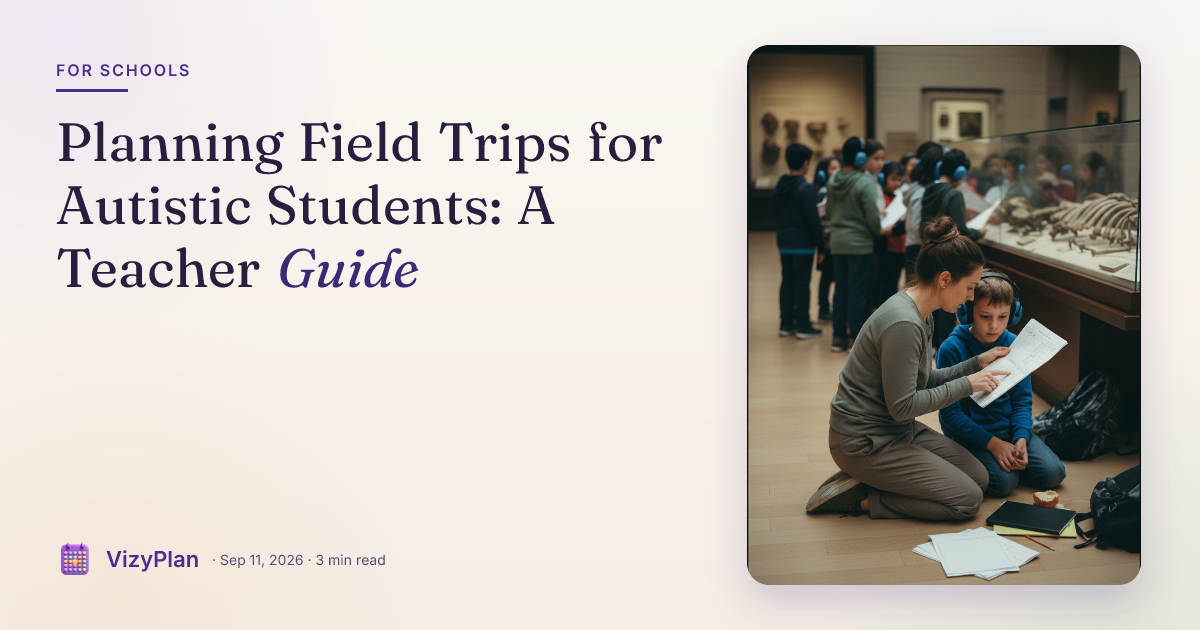
- Plan the exit ramp. A quiet spot, headphones, and the cue that means we step out. Knowing the exit exists is often what keeps a student in.
The coordination behind this is the same one in why the staff handoff breaks down, and the visual side is in visual schedules for the classroom. When a student is left out anyway, families have a playbook in when your child is excluded at school.
VizyPlan was built by an autism dad and a licensed speech-language pathologist so a family can build the field trip routine at home, with real photos, the night before the bus.
Enjoying this article?
Get practical tips and insights delivered to your inbox — no spam, ever.
Share VizyPlan with your families so the schedule you plan for the trip is one the student has already seen at home. The 7-day free trial lets a family try it first. Just $6.99/month after, no credit card required upfront.
VizyPlan was built by an autism dad and a licensed speech-language pathologist who needed something that did not exist. Explore VizyPlan.