Interoception Visual Cues: An OT's Guide to Body Awareness
4 min read
Sit until something happens is an instruction with no visible end, delivered to a child who may not yet feel the signal. No wonder the bathroom has become somewhere they resist going.
Free 7-day trial · No email or credit card to start · Built by an autism dad and an autism mom SLP
Scheduled toilet sitting works far better than waiting for a child to notice a body signal that arrives late or faintly. A short timer makes the sit finite, which removes the open-ended dread that turns toileting into avoidance.
What the research saysA comparison of 40 autistic children with 43 age-matched controls found daytime wetting in 45 percent of the autistic group against 4.7 percent of controls, so toileting difficulty is common rather than unusual.
von Gontard et al., Journal of Pediatric Urology, 2015
Takes about five minutes. Use it as written, or keep only the steps your family needs. A short setup that gets used beats a complete one that gets abandoned in week two.
Extending the sit because you think something is about to happen turns a predictable routine back into an open-ended one, and it is the fastest route to refusal.
The Vizy Timer lives inside the same routine your child already follows, so toilet sitting time is a step with a visible length rather than a separate tool somebody has to remember to open.
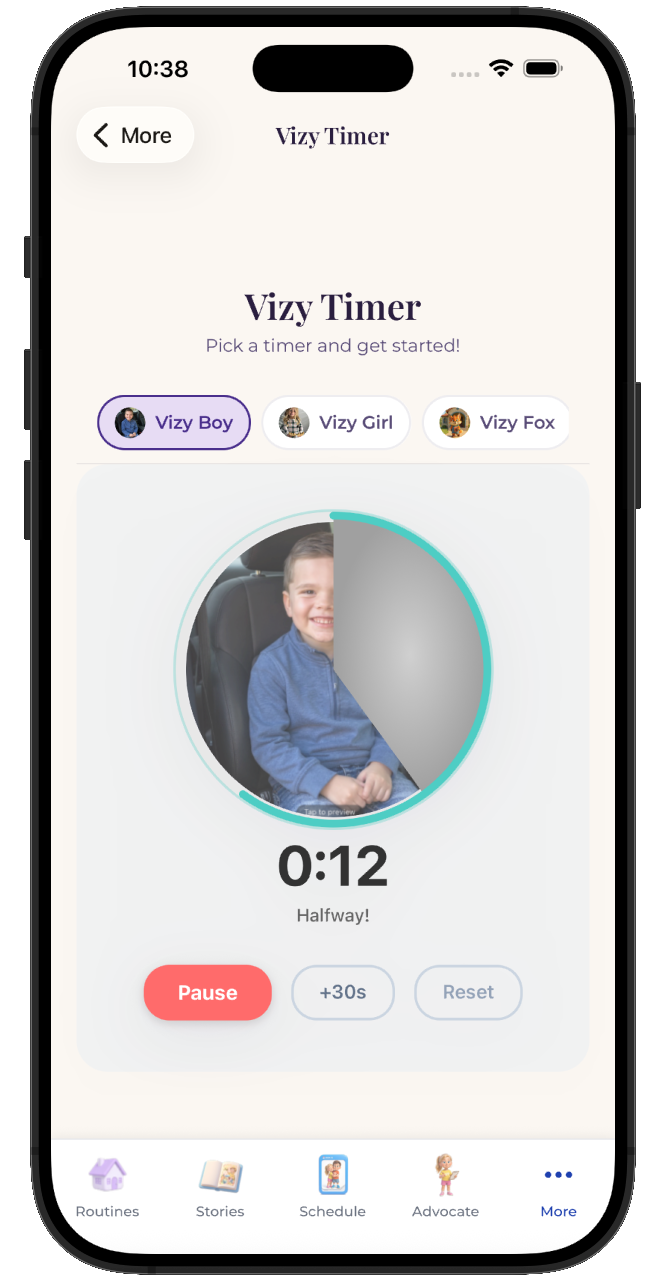
Five minutes to build, and your child sees it every time toilet sitting time comes around.
$6.99/month after the free trial · Cancel anytime · Also at app.vizyplan.com
VizyPlan supports routines and communication at home and school. It is not a medical device and does not diagnose or treat any condition. Talk to your child's care team about clinical questions.