
Teaching Waiting and Patience to Your Neurodivergent Child
8 min read
Wait a minute has never once worked, because a minute is not a real unit to a child who cannot feel time passing. To them, wait means an unknown and possibly endless amount of nothing.
Free 7-day trial · No email or credit card to start · Built by an autism dad and an autism mom SLP
Waiting is a skill made of two parts, tolerating an unknown duration and tolerating wanting something. A story that explains what waiting is, plus something concrete to do during it, addresses both instead of just asking for patience.
What the research saysA meta-analysis of 27 studies found children and adolescents with ADHD perceive time less accurately and sense it passing more slowly than peers, which is why an abstract minute is not a usable instruction.
Zheng, Wang, Chiu and Shum, Journal of Attention Disorders, 2022
Takes about five minutes. Use it as written, or keep only the steps your family needs. A short setup that gets used beats a complete one that gets abandoned in week two.
Teaching waiting without giving your child a way to see the duration asks them to tolerate an unknown, which is the hard part rather than the wanting.
The Social Stories lives inside the same routine your child already follows, so a story about waiting is a step with a visible length rather than a separate tool somebody has to remember to open.
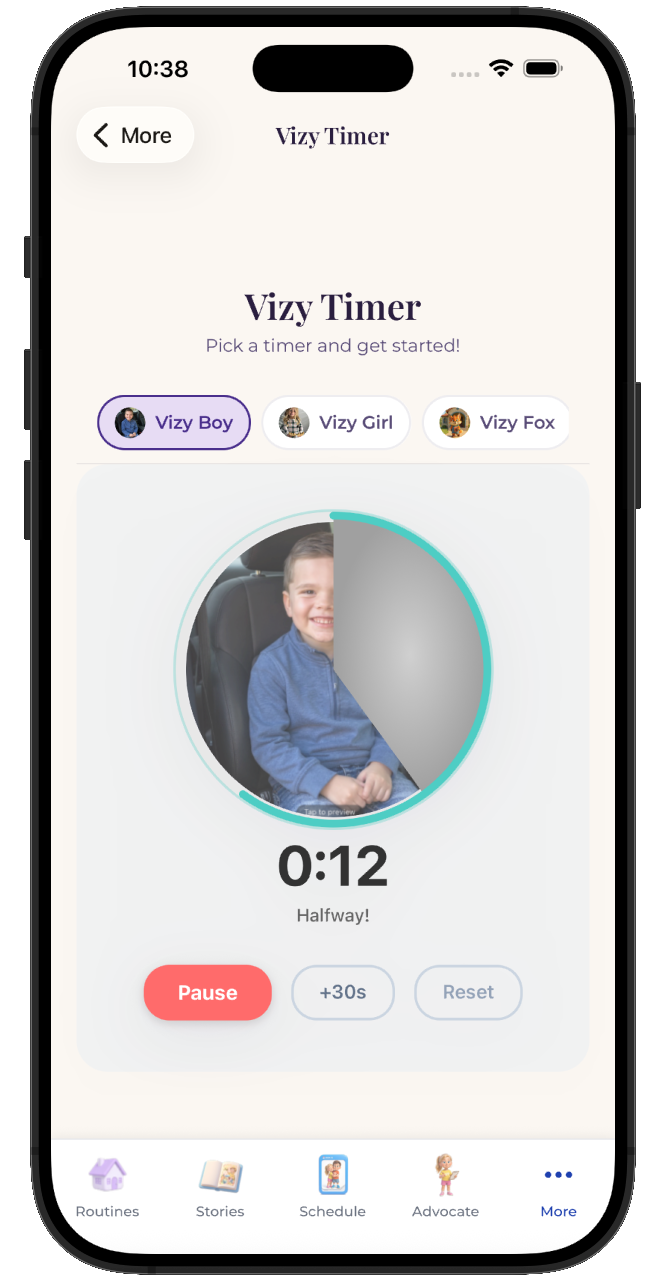
Five minutes to build, and your child sees it every time a story about waiting comes around.
$6.99/month after the free trial · Cancel anytime · Also at app.vizyplan.com
VizyPlan supports routines and communication at home and school. It is not a medical device and does not diagnose or treat any condition. Talk to your child's care team about clinical questions.