
Vizy Countdown

Counting Down When You Do Not Know the Date honestly, rather than guessing.

Your child wants to know when, and you genuinely do not know. The appointment has not been scheduled, the results have not come, the decision has not been made.

Free 7-day trial · No email or credit card to start · Built by an autism dad and a licensed SLP

Why it works here

Why a visual countdown helps with counting down when you do not know the date

A guessed date that turns out wrong costs more than an honest unknown, because it teaches your child that your countdowns are unreliable. Counting down to the next known thing instead gives them something true to hold while the larger question stays open.

You will recognize this if

  • Your child asks about something whose timing you cannot control.
  • You have been vague to avoid being wrong.
  • Previous approximate answers turned out incorrect and were noticed.
What the research says

Intolerance of uncertainty is a recognized contributor to anxiety in autistic children, and a parent-delivered program targeting it directly proved feasible and acceptable to families in a trial.

CUES feasibility trial, 2023
The setup

How to set it up for counting down when you do not know the date

Takes about five minutes. Use it as written, or keep only the steps your family needs. A short setup that gets used beats a complete one that gets abandoned in week two.

  1. 1 Say plainly that you do not know the date yet
  2. 2 Count down to the next known thing instead, such as the day you will find out
  3. 3 Name explicitly what will happen when you do know
  4. 4 Give a range rather than a point if you must give anything
  5. 5 Update the countdown the moment you learn the date
  6. 6 Keep the ordinary routine visible so the unknown is not the only thing on the map
The mistake most families make

Inventing a date to end the questioning buys a few quiet days and costs your child's trust in every countdown afterward.

In the app

Built into the routine, not bolted onto it.

The Vizy Countdown lives inside the same routine your child already follows, so counting down when you do not know the date is a step with a visible length rather than a separate tool somebody has to remember to open.
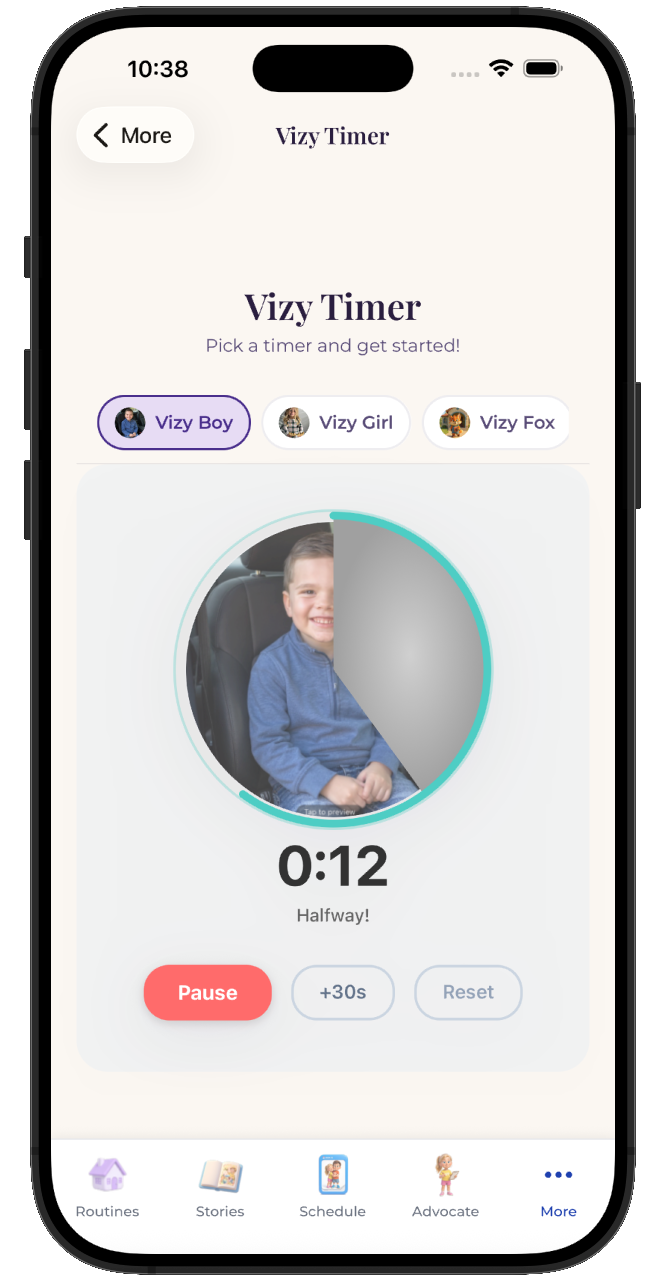
  • Attach it to any step in any routine
  • Works for pre-readers, gestalt language processors, and AAC users
  • Same setup at home, at school, and in therapy
See the step-by-step guide →
The VizyPlan Vizy Countdown set up for counting down when you do not know the date

Set this up for your child.

Five minutes to build, and your child sees it every time counting down when you do not know the date comes around.

$6.99/month after the free trial · Cancel anytime · Also at app.vizyplan.com

Common questions

About counting down when you do not know the date

Is it better to say nothing than to say I do not know?
Saying you do not know, plus what you will do when you find out, is nearly always better. Silence leaves your child to fill the gap themselves.
How do I stop the repeated questions?
Give them a countdown to the next certain thing and point at it. The asking is usually about the uncertainty rather than the answer.
Should I give a rough estimate?
A range works better than a point, and only if you can hold it. Some time in the next two weeks is honest, whereas next Tuesday probably is not.

VizyPlan supports routines and communication at home and school. It is not a medical device and does not diagnose or treat any condition. Talk to your child's care team about clinical questions.