
Social Stories

A Story About Getting Lost written before you ever need it.

You have thought about what would happen if your child got separated from you in a store, and you have never actually taught them what to do about it.

Free 7-day trial · No email or credit card to start · Built by an autism dad and a licensed SLP

Why it works here

Why a social story helps with a story about getting lost

Getting lost is a low-frequency, high-stakes event, which is exactly the category people prepare for least and need most. A story teaches the procedure calmly in advance, so the plan exists before the panic does.

You will recognize this if

  • Your child has wandered off in a public place.
  • They would not know who to approach for help.
  • You hold their hand constantly because you have no other plan.
What the research says

Social stories showed positive effects for safety skills specifically in a meta-analysis of 21 single-case studies, alongside social skills and problem behavior.

Guo et al., Frontiers in Psychology, 2026
The setup

How to set it up for a story about getting lost

Takes about five minutes. Use it as written, or keep only the steps your family needs. A short setup that gets used beats a complete one that gets abandoned in week two.

  1. 1 Teach staying still rather than searching, because a moving child is much harder to find
  2. 2 Name specifically who is safe to ask, such as a person behind a till or in uniform
  3. 3 Practice saying their own name and yours, out loud
  4. 4 Put your phone number somewhere on your child, not only in their memory
  5. 5 Rehearse it in the actual stores you visit most
  6. 6 Read the story before outings rather than only once at home
The mistake most families make

Teaching your child to find you rather than to stay put means two people are moving through a store, which makes reunion considerably slower.

In the app

Built into the routine, not bolted onto it.

The Social Stories lives inside the same routine your child already follows, so a story about getting lost is a step with a visible length rather than a separate tool somebody has to remember to open.
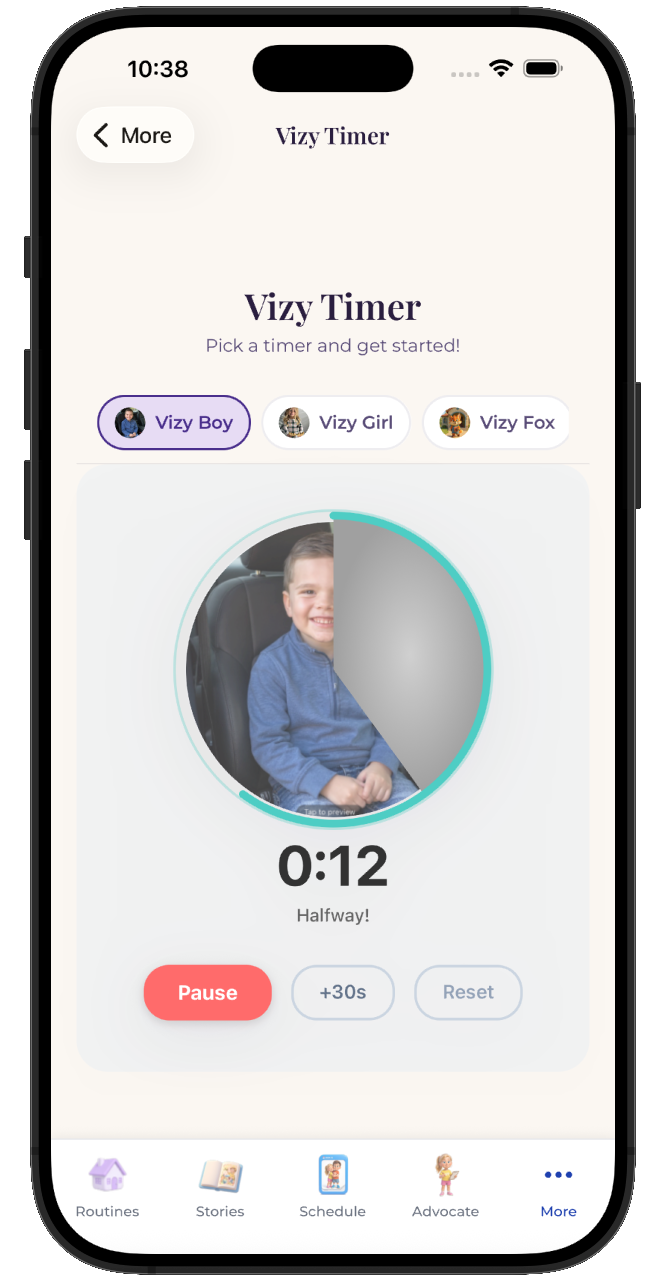
  • Attach it to any step in any routine
  • Works for pre-readers, gestalt language processors, and AAC users
  • Same setup at home, at school, and in therapy
See the step-by-step guide →
The VizyPlan Social Stories set up for a story about getting lost

Set this up for your child.

Five minutes to build, and your child sees it every time a story about getting lost comes around.

$6.99/month after the free trial · Cancel anytime · Also at app.vizyplan.com

Common questions

About a story about getting lost

Should my child look for me or stay still?
Stay still, in nearly every case. Two people searching a large store is much slower than one searching for a stationary child.
Who should they ask for help?
Someone in uniform or behind a counter, which is a rule your child can apply without judging whether a stranger looks trustworthy.
What if my child cannot speak in that moment?
Put the information on them physically, a card or a wristband with your number. Never rely solely on speech in a high-stress moment.

VizyPlan supports routines and communication at home and school. It is not a medical device and does not diagnose or treat any condition. Talk to your child's care team about clinical questions.