Map Your Day

Celebrating Without Overpraising so the praise still means something.

You have been saying good job so many times a day that it has become background noise, and your child has stopped reacting to it entirely.

Free 7-day trial · No email or credit card to start · Built by an autism dad and a licensed SLP

Why it works here

Why a day map helps with celebrating without overpraising

Praise that describes what a child actually did carries information they can use, while praise that simply evaluates them tends to flatten with repetition. Switching from judgment to description keeps the acknowledgement useful without increasing the volume.

You will recognize this if

  • Your praise no longer produces any visible response.
  • You are saying well done dozens of times a day.
  • Your child seems to need praise to continue rather than to start.
What the research says

Cognitive evaluation theory holds that feedback interpreted as information about competence supports intrinsic motivation, while the same feedback interpreted as control undermines it.

Deci, Koestner and Ryan, Psychological Bulletin, 1999
The setup

How to set it up for celebrating without overpraising

Takes about five minutes. Use it as written, or keep only the steps your family needs. A short setup that gets used beats a complete one that gets abandoned in week two.

  1. 1 Say what your child did rather than how good it was
  2. 2 Name one specific thing rather than the whole routine
  3. 3 Praise the part that was actually hard, not the easy steps
  4. 4 Reduce the frequency deliberately and watch whether anything changes
  5. 5 Let the completed map do some of the acknowledging for you
  6. 6 Avoid stacking praise on top of a reward for the same step
The mistake most families make

Praising every step equally makes the genuinely difficult ones indistinguishable from the trivial ones, which is how praise stops carrying information.

In the app

Built into the routine, not bolted onto it.

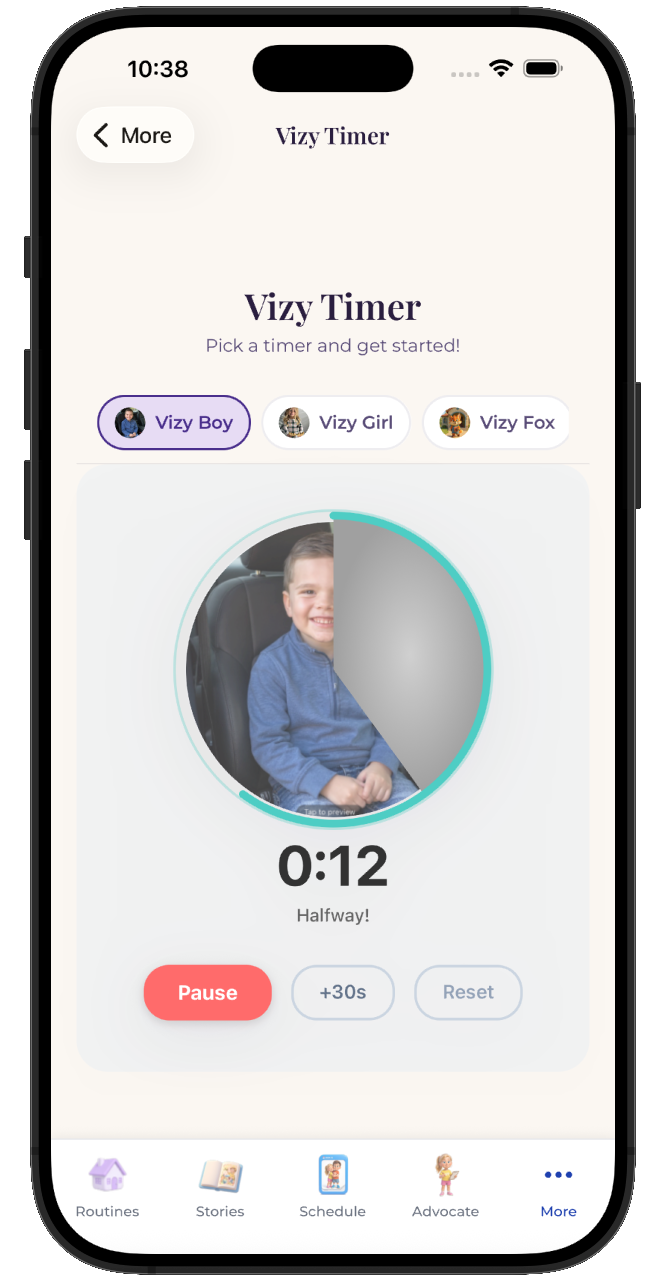
The Map Your Day lives inside the same routine your child already follows, so celebrating without overpraising is a step with a visible length rather than a separate tool somebody has to remember to open.
  • Attach it to any step in any routine
  • Works for pre-readers, gestalt language processors, and AAC users
  • Same setup at home, at school, and in therapy
See the step-by-step guide →
The VizyPlan Map Your Day set up for celebrating without overpraising

Set this up for your child.

Five minutes to build, and your child sees it every time celebrating without overpraising comes around.

$6.99/month after the free trial · Cancel anytime · Also at app.vizyplan.com

Common questions

About celebrating without overpraising

Is there such a thing as too much praise?
Praise that is constant and non-specific tends to stop carrying meaning, and some children begin to rely on it. Specific and occasional works better than frequent and general.
What should I say instead of good job?
Describe what happened. You put your shoes on without me asking gives your child real information, where good job does not.
Should I praise effort or results?
Effort and strategy, generally, particularly where your child's capacity varies day to day. Praising results on a good day makes a bad day feel like a failure.

VizyPlan supports routines and communication at home and school. It is not a medical device and does not diagnose or treat any condition. Talk to your child's care team about clinical questions.