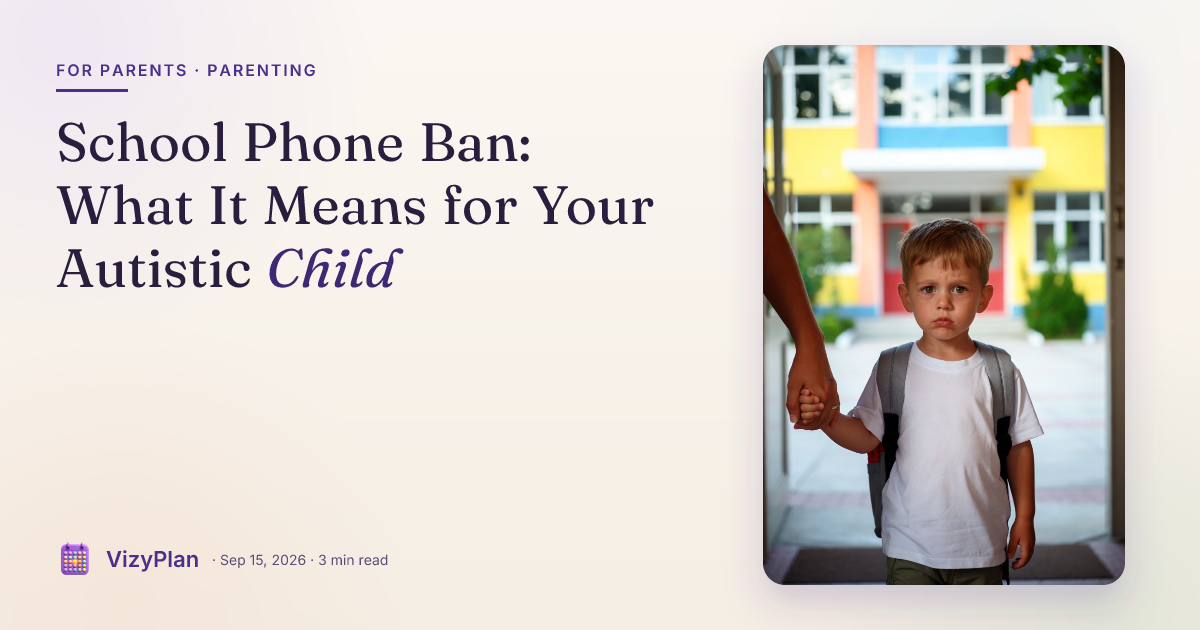
Every kid deserves to carry their own voice and their own calm through the school day. In fall 2026, across most of the country, a phone or tablet in a backpack became a rule violation, and for some autistic kids that device was the voice, the schedule, and the calm. A school phone ban does not have to take any of that away, but the exception will not write itself.
What the school phone ban actually says
As of June 2026, 38 states and the District of Columbia require districts to ban or restrict student phone use. Twenty-nine of them cover the entire school day. Eight, including Michigan and North Carolina, cover instructional time only. Whatever you think of the policy, the paragraph that matters for your family is the exemption. Most of the state laws carve one out for students with an IEP or a documented health need. Michigan's new law, for example, exempts "devices used for special education programming or devices provided as an accommodation to students as required under Section 504 or as part of an IEP."
Federal disability law does not hand out a blanket pass, but it does require schools to make reasonable modifications to a device ban when a student needs the device to access their education. The U.S. Department of Education's assistive technology guidance goes further: every time an IEP team meets, it must consider whether the child needs assistive technology, and a family-owned device can be written in with the school still responsible for supporting it. ASHA's president put the stakes plainly this fall: "AAC devices are not optional accessories. They serve as a child's voice, and we all need access to our voice at all times."
The same logic covers more than speech. A visual schedule, a countdown timer, a calm-down screen, or a glucose monitor on a phone is a support with a job, and schools accommodate jobs.
How to handle a school phone ban when the device is a support
- Read your district's policy, not the headline. Find the exemption paragraph. Instructional-time bans and bell-to-bell bans need different asks, and your district may already have a form.
- Name the function, not the device. Write one line for each job the phone does: speaks for him, shows the next step, runs the calm timer, alerts a nurse. An IEP team can say yes to a function far more easily than to "his phone."
- Get it into the IEP or 504 in writing. Ask for assistive technology consideration at the next meeting and request language like "access to the communication app on the student's tablet throughout the school day, including transitions, lunch, specials, and assessments." If services are already behind, our post on requesting an IEP meeting this fall covers the letter.
- Offer a low-tech backup. A printed schedule or communication board in the backpack makes the request easier to approve and covers the dead-battery day.
- Agree on the boundaries. Which apps, where the device lives when it is not in use, and what happens if it is misused. Boundaries you propose are boundaries you can live with.
- If the answer is no, get it in writing. A written refusal starts the clock on the next step, and when your child is excluded at school walks through what that step looks like.
The ban is the rule for everyone. The exception is the plan for your kid, and it only exists once someone writes it down.
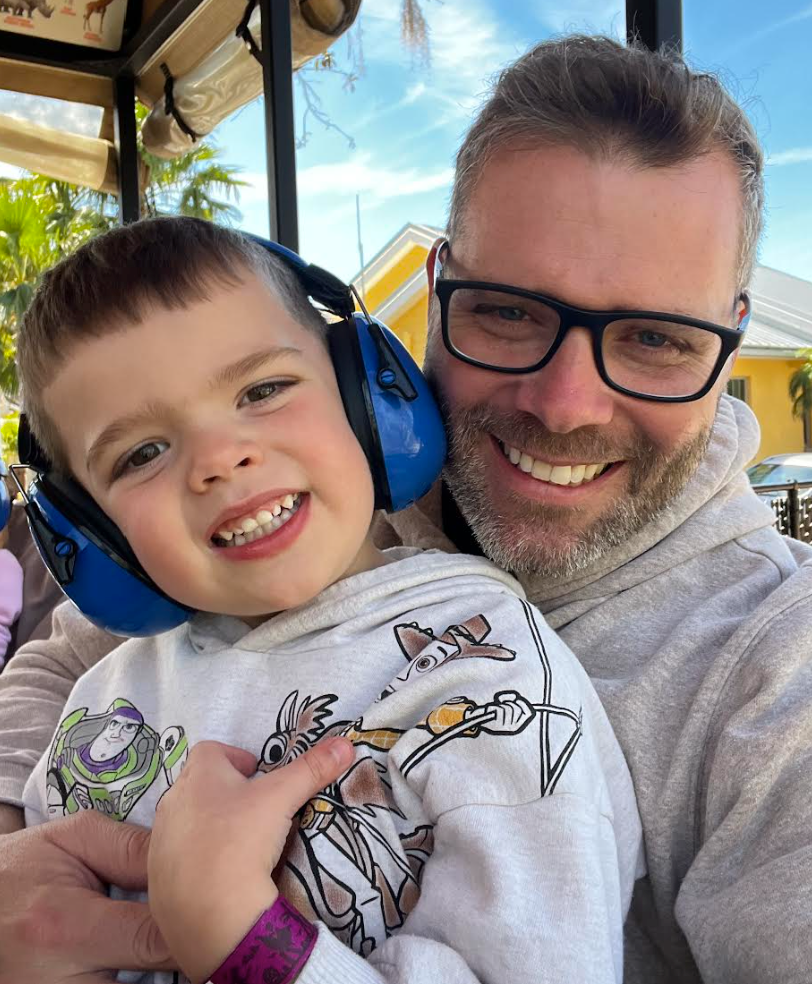
VizyPlan was built by an autism dad and an autism mom who is a licensed speech-language pathologist so the schedule a child relies on can live on a tablet, on paper, and on the fridge at the same time, whatever the school decides about phones.
Enjoying this article?
Get practical tips and insights delivered to your inbox — no spam, ever.
Download VizyPlan and start your 7-day free trial today. Print the day, then carry it on the device the school allows. Just $6.99/month after your trial, no credit card required upfront.
VizyPlan was built by an autism dad and an autism mom who is a licensed speech-language pathologist who needed something that did not exist. Start your free trial.