
Transitions and Change

Welcoming a New Sibling explained before the baby arrives.

A new baby changes the noise level, the attention, and the routine of the entire house. Your older child has no way to picture any of that in advance.

Free 7-day trial · No email or credit card to start · Built by an autism dad and a licensed SLP

Why it helps

Why a visual schedule helps with welcoming a new sibling

A new sibling changes every routine at once, and a child who runs on predictability feels those changes acutely. Showing what stays the same, alongside what changes, gives your child something reliable to hold onto during the adjustment.

What usually goes wrong

  • Crying is a sensory event that cannot be predicted or escaped.
  • Parent attention is redistributed suddenly and visibly.
  • The routine changes in dozens of small unannounced ways.

A picture-first schedule answers the same three questions every time: what is happening now, what happens next, and when it ends. Children who can see those answers stop needing to ask, and the prompting that usually falls to you moves onto the schedule instead.

The routine

What the schedule can look like

A starting point for a new baby at home. Use it as written, or cut it down to the steps your child actually needs. Fewer steps that get finished beat a complete list that stalls.

  1. 1 Look at the countdown to the baby's arrival
  2. 2 Practice the new routine before the baby comes
  3. 3 Meet the baby with a plan for how
  4. 4 Learn the one special job with the baby
  5. 5 Keep the same bedtime routine every night
  6. 6 Use headphones when the crying is too much
  7. 7 Have the daily one-on-one time with a parent
  8. 8 Look at the family photo together

Tip: keep the same order every time. The order is what your child learns, more than the individual steps.

How VizyPlan helps

A schedule your child is actually in.

Clip art shows a child. VizyPlan generates images of your child, doing the step, in a routine you built in a few minutes.

01 · Personalized

Every step, with their own face in it.

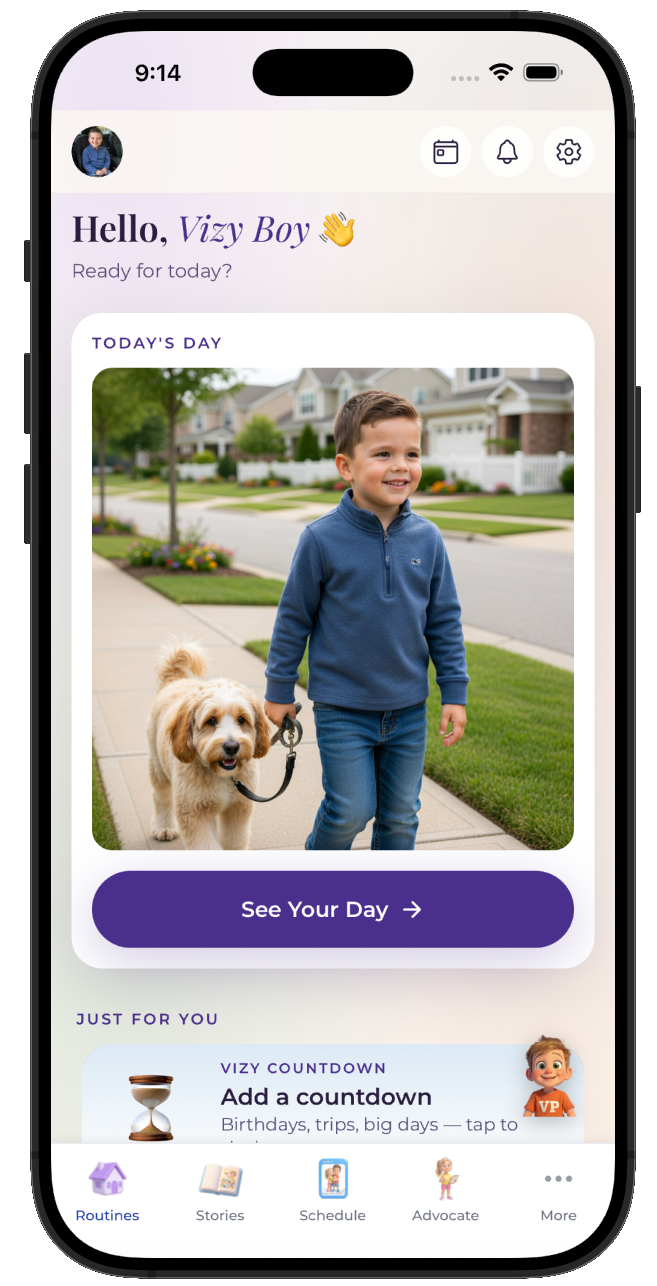
Add one reference photo and VizyPlan generates an image of your child doing each step of a new baby at home. Children attend longer to images of themselves than to generic icons, which is the whole reason the personalization exists.
  • Works for pre-readers, gestalt language processors, and AAC users
  • Reference photos are never used to train public AI models
  • Print any routine as picture cards for low-tech settings
A VizyPlan visual schedule for a new baby at home
02 · Prepared

A social story before the moment hits.

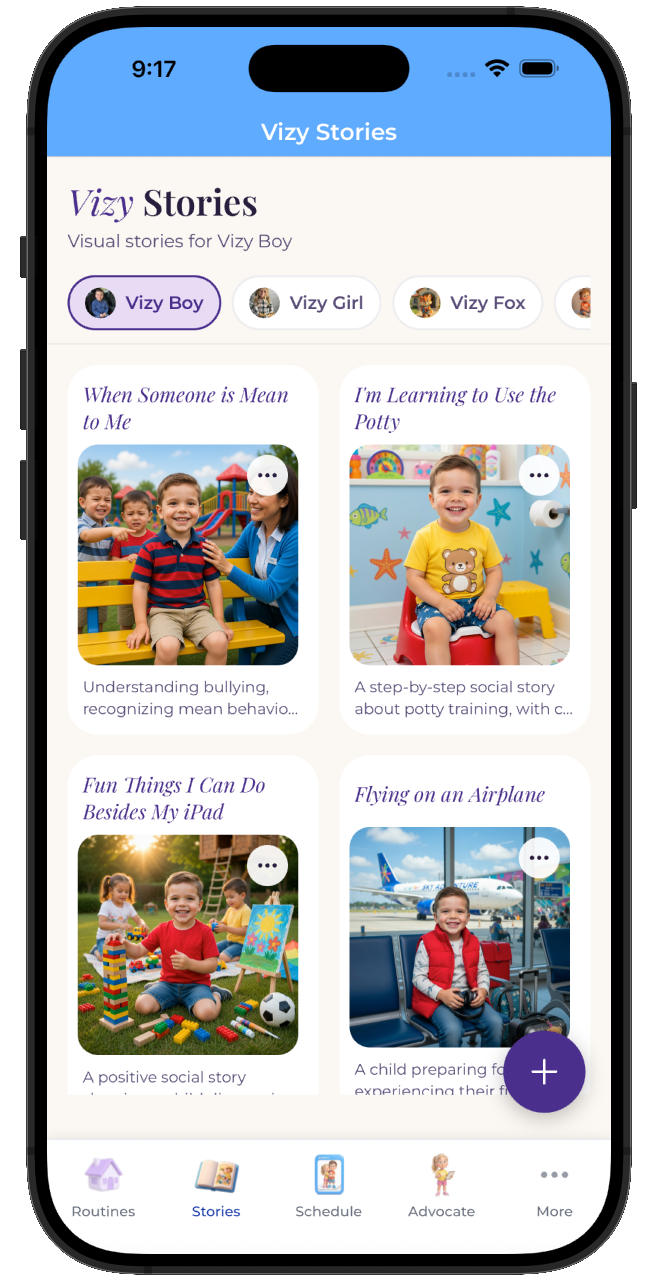
One tap turns a new baby at home into a picture-by-picture story your child reads at home, days before it happens. A child who has already seen it arrives prepared rather than surprised.
  • Read it as many times as your child wants beforehand
  • Share it with the other parent, a grandparent, or a provider
  • Edit any page so the story matches your actual plan
A personalized social story preparing a child for a new baby at home
03 · Regulated

Timers and calm tools one tap away.

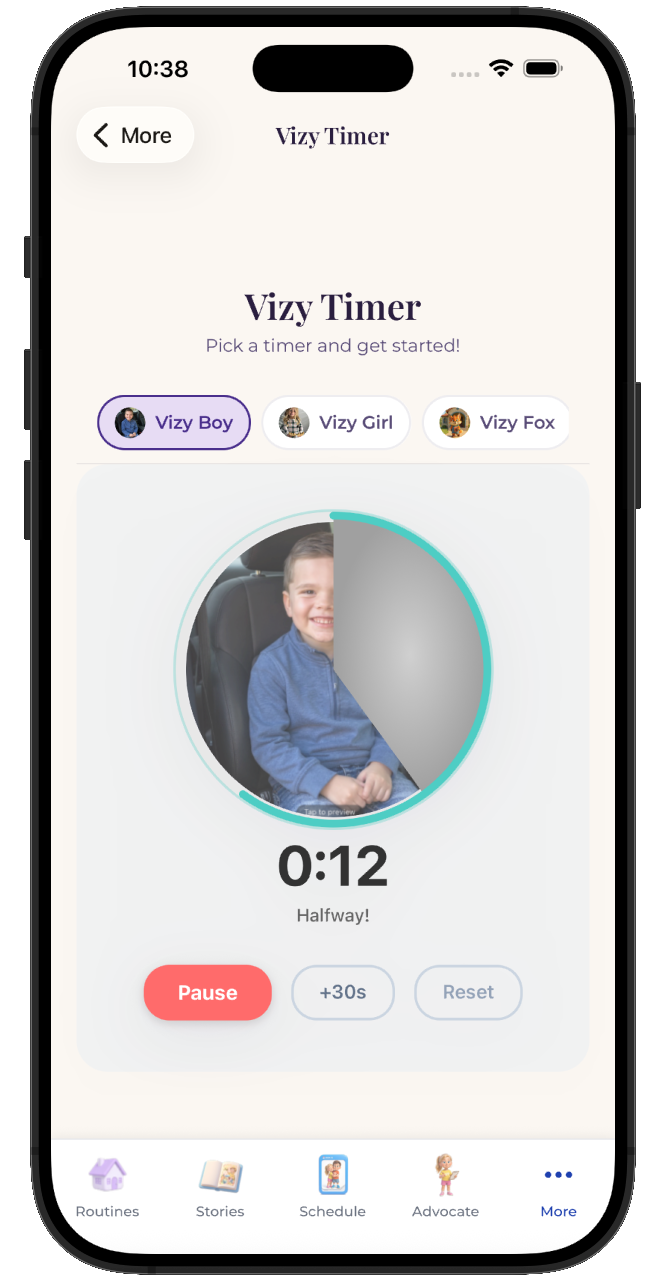
Most of the hard moments in a new baby at home are timing problems. A visual timer that depletes on screen makes the ending visible, and breathing and grounding tools are available from any screen when the plan goes sideways anyway.
  • Visual timers and countdowns for every step
  • Breathing, color, and grounding tools built in
  • Points and stickers for the steps your child finished
VizyPlan visual timer counting down a routine step

Make this schedule for your child.

Set up a new baby at home in about ten minutes, with images of your own child on every step.

$6.99/month after the free trial · Cancel anytime · Also at app.vizyplan.com

Common questions

About a new baby at home

How do I prepare my autistic child for a new baby?
Practice the changed routines before the birth, show what stays the same alongside what changes, and give your child a specific role. Concrete preparation works better than general excitement.
How do I handle the crying if my child is sound sensitive?
Keep headphones accessible in every room and identify a retreat space your child can use freely. Naming crying as something the baby does, not something wrong, also lowers the alarm.
How do I give attention to both children?
Protect a short, scheduled one-on-one block with your older child every day and put it on the visual schedule. Predictable ten minutes beats unpredictable hours for a child who is watching for evidence they still matter.

VizyPlan supports routines and communication at home and school. It is not a medical device and does not diagnose or treat any condition. Talk to your child's care team about clinical questions.