

Social Stories

When a Social Story Is the Wrong Tool before you write the fifth one.

You have written four social stories about the same behavior and nothing has shifted. At some point the honest conclusion is that the story is not the missing piece.

Free 7-day trial · No email or credit card to start · Built by an autism dad and a licensed SLP

Why it works here

Why a social story helps with when a social story is the wrong tool

Social stories deliver information, which means they help when the barrier is not knowing. They do very little when the barrier is sensory, when the demand is too high, or when the behavior is doing a job your child has no other way to do.

You will recognize this if

  • Your child can explain the expected behavior perfectly and still cannot do it.
  • The difficulty is clearly sensory or capacity related.
  • Multiple stories on the same topic have changed nothing.
What the research says

Reviews of social stories report effectiveness for between 51 and 91 percent of participants depending on the study, which means a meaningful minority do not respond and that is a normal finding rather than a failure.

Qi, Barton, Collier, Lin and Montoya, Focus on Autism and Other Developmental Disabilities, 2018
The setup

How to set it up for knowing when a social story is the wrong tool

Takes about five minutes. Use it as written, or keep only the steps your family needs. A short setup that gets used beats a complete one that gets abandoned in week two.

  1. 1 Ask whether your child already knows what to do, and check by asking them
  2. 2 If they know and cannot do it, stop writing and look at the environment
  3. 3 Check for a sensory driver before assuming a knowledge gap
  4. 4 Check whether the demand is simply too large right now
  5. 5 Ask what the behavior achieves, and whether your child has another route to it
  6. 6 Bring it to your child's clinical team rather than iterating alone
The mistake most families make

Writing a fifth story about the same behavior is repeating an experiment that has already returned its result four times. The variable that has not been tested is whether knowing was ever the problem.

In the app

Built into the routine, not bolted onto it.

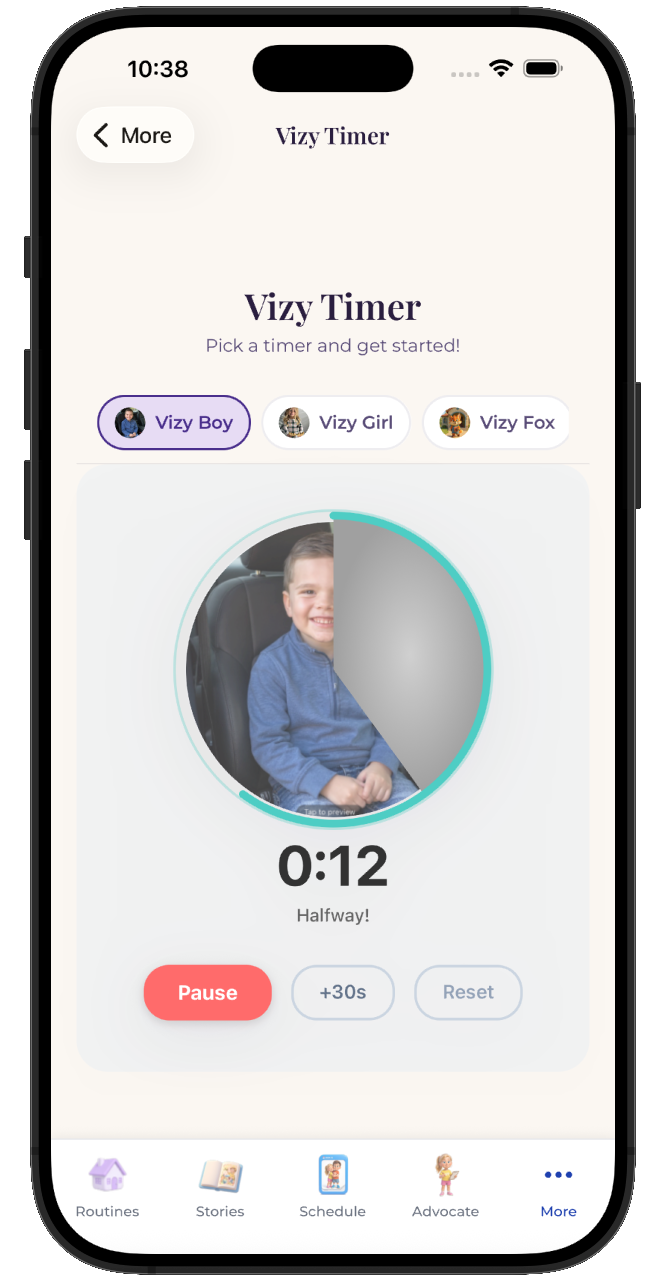
The Social Stories lives inside the same routine your child already follows, so knowing when a social story is the wrong tool is a step with a visible length rather than a separate tool somebody has to remember to open.
  • Attach it to any step in any routine
  • Works for pre-readers, gestalt language processors, and AAC users
  • Same setup at home, at school, and in therapy
See the step-by-step guide →
The VizyPlan Social Stories set up for knowing when a social story is the wrong tool

Set this up for your child.

Five minutes to build, and your child sees it every time knowing when a social story is the wrong tool comes around.

$6.99/month after the free trial · Cancel anytime · Also at app.vizyplan.com

Common questions

About knowing when a social story is the wrong tool

How do I know if knowledge is the barrier?
Ask your child what they are supposed to do, at a calm moment. If they can tell you accurately, the story is not the missing piece.
What works when a story does not?
It depends on the actual barrier. Sensory adjustments, reducing the demand, teaching a replacement skill, or changing the environment all address things a story cannot.
Are social stories oversold?
Somewhat. They have moderate evidence for specific uses, and they get recommended for everything. Matching the tool to the barrier matters more than the tool itself.

VizyPlan supports routines and communication at home and school. It is not a medical device and does not diagnose or treat any condition. Talk to your child's care team about clinical questions.