

Map Your Day

A Map During Burnout when the answer is fewer demands, not better ones.

Your child has stopped doing things they used to manage easily, and every system you have tried to reinstate has made it worse. This is not regression through laziness, and adding structure is not the fix.

Free 7-day trial · No email or credit card to start · Built by an autism dad and a licensed SLP

Why it works here

Why a day map helps with a map during burnout

In autistic burnout the useful direction is down, not up. A map can help by making a deliberately reduced day visible, so both you and your child can see that the demands really have been lowered rather than merely feeling like they should have been.

You will recognize this if

  • Skills your child had reliably have disappeared rather than declined.
  • Rest helps and pressure makes things noticeably worse.
  • Your child is doing less than they were six months ago across the board.
What the research says

Autistic burnout in children presents as a loss of previously reliable skills alongside exhaustion, and reduced demands rather than increased structure are the usual starting point.

VizyPlan, Autistic burnout warning signs in kids
The setup

How to set it up for using a map during burnout

Takes about five minutes. Use it as written, or keep only the steps your family needs. A short setup that gets used beats a complete one that gets abandoned in week two.

  1. 1 Cut the map to the smallest number of activities that keeps your child safe and fed
  2. 2 Remove all points and rewards from every remaining step
  3. 3 Keep the sequence visible so the reduction is obvious rather than implied
  4. 4 Add nothing back for several weeks, even when things improve
  5. 5 Add one item at a time, and be ready to remove it again
  6. 6 Talk to your child's clinical team rather than managing it alone
The mistake most families make

Reinstating the full routine at the first sign of improvement is the most common way a recovery gets undone, and the second dip is usually deeper than the first.

In the app

Built into the routine, not bolted onto it.

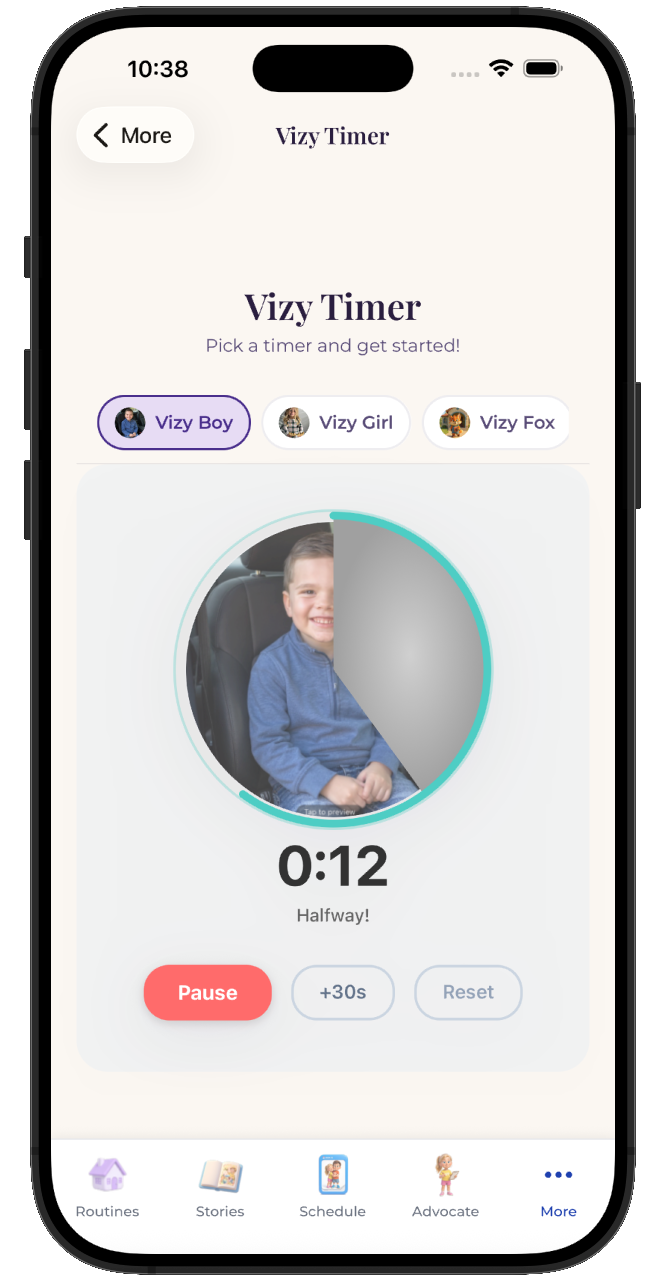
The Map Your Day lives inside the same routine your child already follows, so using a map during burnout is a step with a visible length rather than a separate tool somebody has to remember to open.
  • Attach it to any step in any routine
  • Works for pre-readers, gestalt language processors, and AAC users
  • Same setup at home, at school, and in therapy
See the step-by-step guide →
The VizyPlan Map Your Day set up for using a map during burnout

Set this up for your child.

Five minutes to build, and your child sees it every time using a map during burnout comes around.

$6.99/month after the free trial · Cancel anytime · Also at app.vizyplan.com

Common questions

About using a map during burnout

How long does burnout last?
It varies widely, and recovery is generally slower than families hope. Adding demands back too early is the factor most within your control.
Should I keep the map at all during burnout?
A very short one often helps, because predictability is still valuable even when demands are minimal. What has to go is the volume, not the structure.
Is this the same as regression?
Not necessarily, and it is worth discussing with your child's clinicians. Loss of skills has several possible explanations and deserves a proper look rather than a guess.

VizyPlan supports routines and communication at home and school. It is not a medical device and does not diagnose or treat any condition. Talk to your child's care team about clinical questions.