

Medical and Health

An Occupational Therapy Session from the parking lot to the last swing.

The OT gym is a wonderful place and a hugely stimulating one. Getting in is one challenge, and getting out at the end is often a bigger one.

Free 7-day trial · No email or credit card to start · Built by an autism dad and a licensed SLP

Why it helps

Why a visual schedule helps with an occupational therapy session

Occupational therapy sessions are usually motivating, which makes leaving the hardest transition of the day. Showing the arrival, the session, and the ending in advance, with the last activity named, prevents the ending from arriving as a shock.

What usually goes wrong

  • The gym is stimulating, which makes stopping feel impossible.
  • The activity order changes week to week.
  • A dysregulated ride home can undo the benefit of the session.

A picture-first schedule answers the same three questions every time: what is happening now, what happens next, and when it ends. Children who can see those answers stop needing to ask, and the prompting that usually falls to you moves onto the schedule instead.

The routine

What the schedule can look like

A starting point for an occupational therapy session. Use it as written, or cut it down to the steps your child actually needs. Fewer steps that get finished beat a complete list that stalls.

  1. 1 Check the therapy day on the schedule
  2. 2 Wear the clothes that work best for movement
  3. 3 Drive to the clinic
  4. 4 Check in and wait
  5. 5 Session with the therapist
  6. 6 Do the named last activity
  7. 7 Clean up and say goodbye
  8. 8 Do the regulating routine on the way home

Tip: keep the same order every time. The order is what your child learns, more than the individual steps.

How VizyPlan helps

A schedule your child is actually in.

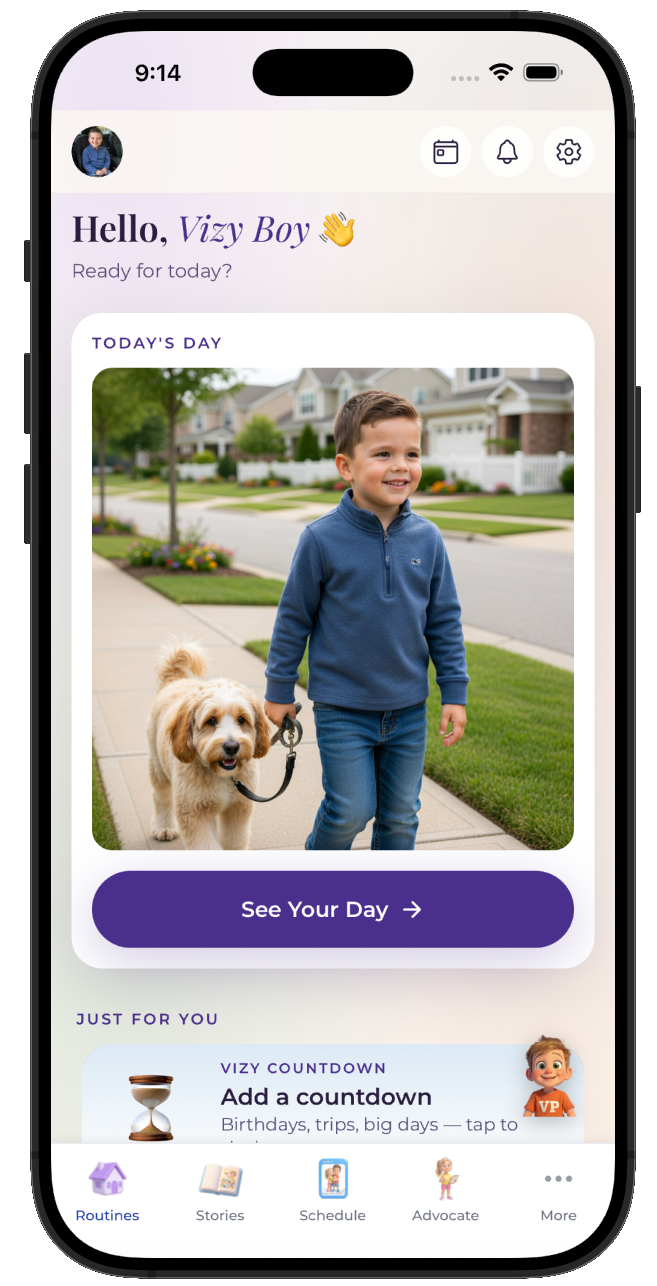
Clip art shows a child. VizyPlan generates images of your child, doing the step, in a routine you built in a few minutes.

01 · Personalized

Every step, with their own face in it.

Add one reference photo and VizyPlan generates an image of your child doing each step of an occupational therapy session. Children attend longer to images of themselves than to generic icons, which is the whole reason the personalization exists.
  • Works for pre-readers, gestalt language processors, and AAC users
  • Reference photos are never used to train public AI models
  • Print any routine as picture cards for low-tech settings
A VizyPlan visual schedule for an occupational therapy session
02 · Prepared

A social story before the moment hits.

One tap turns an occupational therapy session into a picture-by-picture story your child reads at home, days before it happens. A child who has already seen it arrives prepared rather than surprised.

  • Read it as many times as your child wants beforehand
  • Share it with the other parent, a grandparent, or a provider
  • Edit any page so the story matches your actual plan
A personalized social story preparing a child for an occupational therapy session
03 · Regulated

Timers and calm tools one tap away.

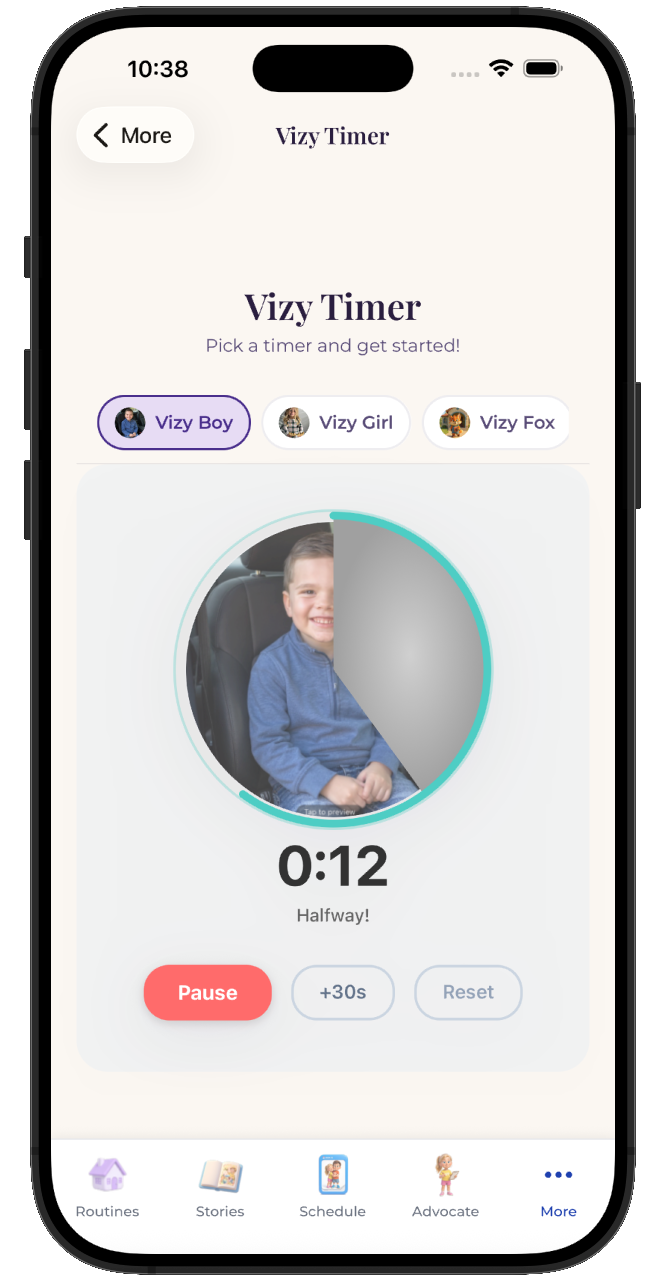
Most of the hard moments in an occupational therapy session are timing problems. A visual timer that depletes on screen makes the ending visible, and breathing and grounding tools are available from any screen when the plan goes sideways anyway.
  • Visual timers and countdowns for every step
  • Breathing, color, and grounding tools built in
  • Points and stickers for the steps your child finished
VizyPlan visual timer counting down a routine step

Make this schedule for your child.

Set up an occupational therapy session in about ten minutes, with images of your own child on every step.

$6.99/month after the free trial · Cancel anytime · Also at app.vizyplan.com

Common questions

About an occupational therapy session

Why does my child melt down after occupational therapy?
A stimulating session can leave a child both regulated and depleted, and leaving a preferred environment is a hard transition on top of that. A predictable last activity and a calm ride home usually resolve it.
What does an OT actually work on?
Occupational therapists address sensory processing, fine and gross motor skills, and the everyday tasks of childhood such as dressing, handwriting, and self-care. Ask your OT which daily routine to target next so the work shows up at home.
How do I keep the sensory strategies going between sessions?
Ask for two or three strategies to build into routines that already exist, and put them on the daily visual schedule. Strategies with a fixed place in the day get used, and strategies stored in a handout do not.

VizyPlan supports routines and communication at home and school. It is not a medical device and does not diagnose or treat any condition. Talk to your child's care team about clinical questions.